Visar inlägg med etikett My Heroines. Visa alla inlägg

fredag 30 juni 2017

The development of Phryne Fisher

Bort ifrån en stad nå'nstans i Sverige flyr en kvinna.  
Hon har flytt så många gånger förr  
Varje gång är det svårt
Varje gång hon blir bortdriven,
Stänger hon en inre dörr. 
Och där bakom dörren skapar hon sin egen himmel
Svarta silhuetter emot skyn
De är där, hennes folk
Det är vännerna som träder fram 
För hennes inre syn

Svarta silhuetter
Tusen och en nätter
Allt går om och om igen
Skuggorna är långa
Drömmarna så många
Långt ifrån och länge sen

(Away from a town somewhere in Sweden a woman runs. She has fled so many times before. Every time it is hard. Every time she gets driven away, she closes an inner door. And there behind the door she creates her own heaven, black silhouettes against the sky. They are there, her people. It is the friends who appear before her inner sight. Black silhouettes. One thousands and one nights. The shadows are long. The dreams are many. Far away and long ago.)

 ~ Svarta silhuetter, Hjälp sökes; 
Björn Ulvaeus & Benny Andersson
 
The lyrics above is an extract from the song Svarta silhuetter (Black Silhouettes - a link to Sofia Pekkari singing the song can be found here) from the musical Hjälp sökes (Help wanted) written by Swedish writer Kristina Lugn and with music by Björn Ulvaeus and Benny Andersson from ABBA. I had not heard about it until recently, but I will save that story for another entry. The second verse of Svarta silhuetter had me thinking about Phryne Fisher and I realised it is about time that I made an update of the entry I made about 14 months ago as sort of the start up to this blog. After that I have discussed her character a few times, not least in the entries about Blood and Circuses and now it is time to discuss her a little bit more. There are some differences between Phryne's book and television persona and this entry will focus entirely on the TV version. I have not finished all the books yet and TV-Phryne is therefore the one I know best.

A plotline created for the TV show is that Phryne has a little sister called Jane who got kidnapped and murdered by Murdoch Foyle when they were children. He has never confessed to the kidnapping and the only reason why he is in jail is because of a failed kidnapping attempt on another girl. The main reason why she returns to Melbourne is to prevent him from getting out of jail and this is the overarching plotline of the first season.


Jack: "That wouldn't have anything to do with you barging in there like a freight train, would it?"
Phryne: "I was a charming freight train."
~ Death by Miss Adventures

Phryne is not exactly open about her past, neither does she seem to reflect to much upon either that or the future. Her hedonistic, adventurous side makes her live in the here and now and also from time to time a little bit careless of other people's feelings. Especially Detective Inspector Jack Robinson's who calls her a freight train in Death by Miss Adventures. Phryne does not deny this either, just commenting on the fact that she is a charming one. This indicates that she has self-distance and do realise her flaws.

Phryne grew up in the poor neighbourhood of Collingwood in Melbourne, something that she actually seems pretty proud of. She knows where she is coming from and does not shy away from it. Instead she uses it as a strength both in her professional and personal life.

From what I gather, her father inherited money and a title pretty soon after Jane disappeared when Phryne was still a child. They moved to England and I think this is where Phryne's life "on the run" really started. The move both geographically and socially must have felt like a great relief, but I think Phryne also learned that the easiest way out of situations that demand deeper thoughts and feelings is to flee.

Someone I know's first reaction to Phryne was that she was a shallow female James Bond archetype which is a very common comparison, not least from the author Kerry Greenwood and the producers behind Miss Fisher's Murder Mysteries Every Cloud Productions. I have talked a lot about how I think this is a degradation of Phryne in previous entries (e.g. here) and also that I think the Astrid Lindgren girls (especially Madicken) is a far better comparison (e.g. here). I will not repeat that argument here (you have to read the linked entries if you want to see my thoughts on the subject), but I have for a while thought about if there is anything to the claim that Phryne is a shallow character.

To be honest, my first instinct was to yell a firm no, but the more I thought about it and also did some rewatches of the series, the more I realised that it is not really true, but there is something to it anyway. Phryne does appear shallow at first glance. From time to time she also seems to make herself appear shallow to get what she wants (mainly from men), which is evident for example in her first meeting with Jack.

In a way, I think the whole first season is about her maturing. I would not say that she grows up, because she is totally capable of taking care of herself like an adult. But the Phryne that steps off the ship in Melbourne in Cocaine Blues is not really a mature woman. This is especially evident in the scene from Murder on the Ballarat train when she hangs out from the end of the train. I cannot see her doing that in season 3.
"I haven't taken anything seriously since 1918"
 ~ Phryne Fisher, The Green Mill Murders
How she handles the war and her relationship with René Dubois also indicates her flighty lifestyle before she returns to Melbourne. I also get the feeling that while obviously meeting a lot of people during that time, she does not really form any deeper connections to those people. They more ressembles "black silhouettes". Of course she has her family and there is Elizabeth "Mac" Macmillan (I get a feeling that we have not really explored their backstory at all on the show really), but no one that she meets on a daily basis. There is another song from Hjälp sökes called Den jag ville vara (The one I wanted to be - sung again by Sofia Pekkari here).


Människan är skapt för att tänja ytterligheter
Bortesta gränsen 
Dömd att för evigt försöka flytta staketen
För existensen

Den jag ville vara
Hon som vågar språnget
Ut i själva livet
Hon som vet att inget är avgjort och givet
Henne ska jag bli
Någonstans i tiden 
Ska den andra kvinnan bli till
Hon är jag om jag vill
Stark och vig tar hon ett språng
Den jag ville vara
Ska jag bli en gång
(Humans are created to stretch the extreme. She who dares the leap out into life itself. She who knows that nothing is decided and given. She's the one I will become. Somewhere in time the other woman will be created. She is I if I want to. Strong and agile she takes a leap. The one I wanted to be, I will become once. )
 ~ Den jag ville vara, Hjälp sökes; 
Björn Ulvaeus & Benny Andersson

When she returns to Melbourne, she almost immediatelly meets pretty much all of the mis-matched group that will form her new family. She does not let them in easily, but she starts caring enough about them so she keeps them close.

Jack tells her at the end of Blood at the Wheel that he will never try to change her, but in a way he already does. I think that is one of the best signs for a healthy relationship of any kind (not just romantically). The people we attach ourselves to, (un)consiously starts to rub off on us. This so we can actually make room for them in our lives. Phryne is probably not used to this attachment. She contiunes to just move along like "a freight train", not realising that she can actually hurt people until she already has. This is especially true when it comes to Jack who, on the other hand, spend pretty much all of his time in reflective mood.

But it is not only the people in Melbourne who has Phryne stop unning. No, the main reason behind her return is because she is more or less forced to meet her past when Murdoch Foyle is about to be let out of prison.

Guido Lupinacci says in Murder and Mozzarella that there is no future in the past. I can see where he means, but as an archaeologist I cannot totally agree. In fact I would say there is lot of future in the past. Not least for Phryne. My motto is that you cannot move forward unless you look backwards. That is really the main reason why I dig downwards. (För att komma framåt måste man se bakåt. Det är därför jag gräver nedåt). This does not mean that you should live in the past. On the contrary, you always need to start from the present. I can go on and on about the the importance of the past for both the present and the future, but that is a topic for another entry.

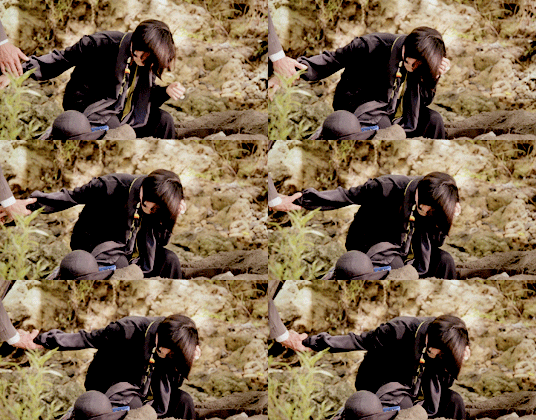
Phryne's own actions during the first season of Miss Fisher's Murder Mysteries also go totally against Guido's quote. During the first season she needs not only to face Foyle and Jane's kidnapping/murder, but also René and she comes out of all of it stronger. I find the moment when Phryne reaches out her hand and Jack grabs it at the site where Jane's body has been buried a prof of how much she has evolved throughout the season in regards to having people around. She's not fleeing. She faces her past, present and future all at once. She lets people in. They are not only black silhouettes. They are there to catch her when she falls.


lördag 8 oktober 2016

My Heroines: Rory Gilmore


Today's birthday girl is Lorelai "Rory" Gilmore (Alexis Bledel). She was born 4:03 AM on October 8 1984 and is the daughter of Lorelai Gilmore and Christopher Hayden and together with her mother the main character of the TV series Gilmore Girls and one of my biggest Heroines!


Rory is very close to her mother. Lorelai was only 16 when she had her and the two of them are therefore often more friends than mother and daughter. She often has a much more difficult relationship with her father. Christopher has never rejected his daughter, but Lorelai has spent most of the time raising Rory alone. Later on, Christopher gets to try single parenting himself, when his partner Sherry abandons him and their baby girl Georgia, called Gigi (A nickname also being a tribute to the series itself - GG.).

Rory and her mother Lorelai
Rory is kind, clever and in the beginning of the series, her biggest dream is to go to Harvard and study journalism and political science. To achieve her goals, she gets into Chilton Academy. It costs a small fortune and Lorelai at last goes to her estranged parents, asking for a loan. They demand a weekly dinner with their daughter and granddaughter.

Rory lives in the small town Stars Hollow where everyone knows each other. When asked about her lack of social activities, she tells the principal of Chilton that living in Stars Hollow itself is kind of a social activity. She is much beloved, by the other townspeople and in the first few seasons quite sheltered.


She graduates from Chilton at the end of season 3 and decides, after a lot of thinking and pro-/con-list writing to go to Yale, her grandfather's alma mater, where other aspects of life than books and studying, sort of starts to sip into her world in a way they have not done before.

Rory is a very special character to me. Not only because she was born only two days before me (My date of birth is October 10 1984.), but because she was the first fictional character I could really relate to. Just like me Rory is sort of nerdy and takes a great interest in school and learning. she is very smart and proud of that.  And the greatest thing about it is that neither the other characters nor the show itself looks down upon her because of it. Because she had Rory so early, Lorelai did not get to go to college, but it is evident that she still reads a lot and no one beats either Gilmore Girls in knowledge about pop-culture.

Rory and Jess
Neither of the Gilmore girls are dependent on men either. They have men in their life from time to time and also goes through some heartache, but they are still independent character with their own lives and free will both in and out of relationship with men.


Another reason why I connected on a quite deeply level with Rory has to do with her relationship to books. We both read just about everything we come over and things she did (like bringing many different types of non-school-related-books to school just because she does not know which one she wants to read during lunch or bring books to parties no matter that there will not likely be any down-time) I thought I was the only one doing.


Gifs from Tumblr. Pictures from here, here, here and here.

söndag 21 augusti 2016

My Heroines: Eva

Nej, jag vill inte sy sömmar på symaskin. Och inte spela skådespel på någon scen. Och inte sätta rovor på is, som skridskoprinsessa. Inte sula slitna skor i skomakeri. Och jag vill inte bli nå'n snabb och smidig servitris. Och faktiskt inte heller, nå'n skolpolis. Utan S som i sångerska... (No, I do not want to sew seams on a sewing machine. And not perform on any scene. And not fall on ice like an ice princess. Not become a shoemaker. And i do not want to be some fast and flexible waitress. And not even a school police. But S like in singer.)
~ Eva, S som i sångerska, Fem myror är fler än fyra elefanter
Eva with Magnus (left) and Brasse (right)
Eva (Remaeus) belongs to the group of heroines that I have had the longest. She was the only female host in the famous Swedish child programme Fem myror är fler än fyra elefanter (5 ants are more than 4 elephants). The show was made as a Swedish version of Sesame Street back in 1973, but it manages to actually be better. (For one thing they have a female main host!) It was remade into a "julkalender" in 1977, the only one to ever startstarting before 1 December and therefore had more than 24 episodes. This so it could contain all the 28 letters in the Swedish alphabet (W was not considered a separate letter in Swedish until 2006. It is treated as a variation of V and is mainly used in names and loanwords.). The show is made up of fun sketches, songs and jingles meant to educate children.

Today all three of the hosts have died and when the last one of them (Magnus Härenstam) past away last year, there were lots of discussions about the show. It was generally praised, but considered to portray old-fashioned gender roles with Eva being a "prima donna". This, however, was not something I could remember, so I decided to rewatch the julkalender version on SVT:s Öppet arkiv. I think the show holds up pretty well from a gender perspective actually. Especially in comparison with gender roles in many children's shows of today. Yes, she is a prima donna from time to time. She is motherly, mainly towards Brasse (Brännström) who is supposed to be the child of the show that the young audience will learn together with, but also towards Magnus. And she is certainly the object of both boy's affection. However, she is actually much more than that! She is very active in every sketch she participates in and she is never over-shadowed by the boys. (It is more like Magnus and Brasse are trying to overshadow each other from time to time as part of their characters.) Considering the activities she is allowed to engage in, I will not call it anti-feministic either. She is an astronaut, a doctor (while Brasse is a nurse!!!) and a scientist and she gets to win sports they engage in. In a couple of sketches she also repairs a bike and in one of those Magnus is also scrubbing the floor at the same time. In none of this cases, her gender does not limit her ability. This is something extremely good and should be brought into the light more in the analysis of the show and not just her role as the show's prima donna.

Unfortunately, Eva Remaeus got a brain tumor and died at the age of 42 back in 1993, so she did not get to experience the show becoming a true Swedish children's classic. Maybe her early death also contributes to her not being mentioned in some of the interviews Brasse and Magnus made about the show in later years. (Brasse died in 2014 and Magnus in 2015.)

To finish on a more positive note though, I am going to let Eva teach you how to count to 20 in Swedish. And remember; five ants will always be more than four elephants!


Video from Youtube, The rights are SVT:s thought. Picture from here.

söndag 17 juli 2016

My Heroines: Katarina Örnfot

A union of the Nordic countries called the Kalmar union, was established by Queen Margareta in 1397 and in 1997 there was therefore a big jubliee in the Swedish town Kalmar (which gave its name to the union.
Swedish Television (SVT) has usually a special show for children in the mornings during the summer holidays. In 1997 the plot of that show told the story about Nils Svensson who has a great interest in knights and travels to Kalmar in 1997 to take part of the jubilee and through his mobile phone ends up in Kalmar 1397. There he befriends Erik of Pomerania who was crowned king in the last episode and the rather clumsy knight Riddare Rosenstråle. His best friend, however, is Katarina Örnfot (Anna Rydgren).

Katarina is the daughter of the knight Bengt Örnfot and most of her other family died from the plague. She has had a brother named Karl too. He was a squire. Bengt was injured in the war against the, so called, mecklenburgarna* and cannot fulfil his duties as a knight. Because of this Karl is given the task of representing him so the family can keep their position in the nobility. The big problem is that Karl died in battle with mecklenburgarna. This is kept a secret between Katarina and her father to not jeopardise their social position. Also because of this, Katarina takes on the role as squire and becomes the best rider in all of Kalmar. The reason why it has to be kept a secret is because women were not allowed to become knights, something they also clearify many times in the show. However Katarina's story might not have been so fictive as you might have thought.

The general picture of the woman in the Middle Ages have changed a lot in recent years and Katarina seems to reflect this. The portrayal of the woman in the Middle Ages was actually one of the main problems I had with SVT:s julkalender (christmas calender) Tusen år till julafton (1000 years to christmas eve) last year (2015).

Tusen år till julafton depicted the medieval woman as precluded from society, trapped in some castle all the time and boring in general. A picture that has been questioned a lot by researcher of the last decades. Katarina is a strong contrast to this picture. She is actually quite the opposite: colourful and independent. She takes an active role in her society and she is never overshadowed by her male companions in the show.

I like the plotpoint of her being a squire and later dubbed as a knight in her own name. I can also oversee with the anachronism of this because they explained that women were not allowed to become knights so much. It is a perfect example of how you, inside the frame of a fictive historical narrative can problematize an issue from the time period in which the story takes place. It legitimize the liberties taken by the people behind the story. This is one of the biggest issues (besides showing an outdated picture of the medieval woman) that I have with Tusen år till julafton as well. In the episode that portrayed the noble classes of the Middle Ages, they had both a woman being a knight and also a girl training to become one and they never revealed anything about the fact that women could not become knights! (In fact they were often rather hard on real historic girls in that calender, but that is a topic for another entry.)

In recent years a lot of research has shown that Katarina might not have been alone. There are quite a lot of female warriors and not least female defenders throughout the Middle Ages (There is actually a Swedish website called Kvinnliga krigare about them.). In fact Erik of Pomerania was surrounded by them. Margareta's way to all the Nordic thrones did not come easy and Erik's wife Philippa/Filippa (daughter of Henry IV of England) is known to have defended Copenhagen during an attack from the Hanseatic league in 1428. The medieval, European society seems to have required a man even during times when they were not present. A fact that Katarina depicts beautifully.

Unlike, for example, the character Brienne in Game of Thrones, Katarina is not reduced to being "just one other tomboyish female who gets to play knight" either. She also has a side to her that would probably be seen as traditionally female. She is caring and from time to time also quite motherly towards the boys in the show. She is allowed to show a much better and varied picture of a female character and I love characters like that! They are not reduced to stereotypes, which I think makes them seem more real. I also love how much research really seems to have gone into the show. Nils meets people that did really live in Kalmar during the late 14th century! They also seemed to have a plan on what they wanted to tell and how. It was more than just entertainment. Like with Horrible Histories, they wanted to educate children and managed to do so very well. It is a shame that there was not so much follow up to the interest the show got from the audience.

The theme of the show was the 14th century ballad Douce Dame Jolie by Guillaume de Machaut.


The autograph I got from the actress Anna Rydgren who
played Katarina.
I know I kind of bashed Tusen år till julafton a lot in this entry, but I was kind of disappointed even though they managed pretty good we a lot of things (e.g. with explaining the estates of the realm during the 17th century). My measurements for good educational shows about history are Salve and Horrible Histories and Katarina and the medieval women Horrible Histories portrays (for example Jeanne d'Arc and Black Agnes) are really so much better representations of what a woman of that time period was like. This is really why I have so much problem with the calendar's portrayal of them which I felt was prejudiced and also somewhat condescending.


*Mecklenburgare is the term used for the supporter of  Albrekt of Mechlenburg who ruled over Sweden before Margareta seized also the Swedish throne. They are depicted as the antagonists of the show.

tisdag 24 maj 2016

My Heroines: Ronja rövardotter

In this third entry to My Heroines series, I stay in Astrid Lindgren's universe. I have a hard time not loving her books. They have meant so much to me since I was very little and Ronja rövardotter (Ronja the robber's daughter) (1981) and Madicken were both among the first books I read all by myself. Madicken has already got her own entry on this blog and this will focus on the character of Ronja.

Ronja is born in the Mattis castle a stormy night when the harpies (That is the translation I have seen for vildvittror.) roamed the sky. She is the daughter of the robber's cheif Mattis and his wife Lovis. Mattis loves his daughter right from the very beginning and is kind of over-protective, but at the age of about 11, Ronja is free to roam the Mattis forest around the castle on her own. He tells her to beware of certain things however and Ronja spends her day watching out for those things. She also meets a boy called Birk Borkason. He was born the same stormy night as herself in another robber's castle. As his name indicates, he is the son of Mattis's archenemy Borka. However, Ronja befriends him and the start playing together in the forest.
Skalle-Per: "Mitt hjärtas fröjd och glädje. Vart är du på väg?" ("My heart's delight and joy. Where are you going?")
Ronja: "Jag ska gå och akta mig för att trilla i älven." ("I am going to beware of falling into the river.")
Skalle-Per: "Och var ska du göra det då?" ("And where are you going to do that?")
Ronja: "Ja, jag måste ju göra det vid älven om det ska vara någon nytta med det." ("Well, I have to do it by the river if there will be any point to it.")
Vildvittror
Ronja is kind of a Romeo and Juliet type of story and can definitely be viewed as fantasy even adults can enjoy. Reading it now as an adult I did have a totally different view of the story's focus then I did as a child. When I was little I always saw Ronja and Birk friendship as the main focus, but nowadays I kind of think that it is more Ronja's relationship with her father that is most important.

Astrid Lindgren seldom wrote about "traditional" heterosexual love between an adult male and an adult female (There are exception for example in Samuel August i Sevedstorp och Hanna i Hult, which is a biographical story about her parents love.). It is obvious that Ronja and Birk love each other, but it is never openly addressed. They call each other sister and brother and their love seems to be totally asexual and there is never any pressure for them to marry. I think this is natural since they are both 11 and I have always had a hard time thinking many people (either boys and girls) think about getting married so early. I certainly did not. Unlike Romeo and Juliet, Ronja and Birk do not commit suicide. Instead they work together to make their fathers stop fighting.
"Du barn, i de där små händerna håller du redan mitt rövarhjärta. Jag begriper det inte, men så är det." ("You my child, you already hold my robber's heart in those small hand. I don't understand it, but it is the truth.")
~ Mattis
Mattis and Ronja
The lack of "traditional" heterosexual relationships in her stories, does not mean that they lack love all together. Quite the contrary! They are full of love. Lindgren's focus on the children means that the love she portrays is types that is closest to them: the love of a sibling or a parent (or parental figure). The latter is especially true in Ronja rövardotter and the love between Mattis and Ronja is probably one of the strongest in her authorship. It seems to be so strong that it physically hurts them from time to time and the most emotional parts of the story are about them and the love they share.

The fact that Mattis and to a somewhat lesser extent Lovis is fully fletched characters, important to the plot makes them quite unique in Lindgren's authorship. You can argue that the adults in Emil in Lönneberga and Madicken are ever present in the story, but not at all to the extent of Mattis and Lovis. In fact, most of the time the parents are put in the background even though it is evident that they do care and love their children.
"Ta av dej min skinnrem först", sa Ronja och reste sej. "Jag vill inte vara hopbunden med dej längre än nödvändigt." ("Take of my leather strap first", said Ronja and rose up. "I don't want to be tied to you longer than necessary.")
(---)
"Nej, det förstås", sa [Birk]. "Men efter det här är jag kanske bunden till dej ändå. Utan rem." ("No, of course", [Birk] said. "But after this I might be tied to you anyway. Without the strap.") 

The settings in Ronja are kind of characters in their own right. The Mattis castle is the first milieu we encounter as it is where Ronja grows up. Symbolically enough, it is split in two by the lightning the night she is born (as it turns out, Birk is also born that same stormy night), creating a deep gorge in between called Helvetetsgapet (the Gap of Hell). Ronja goes up to the top to "beware" of it (as Mattis has told her to) and meets Birk for the first time. He and the other Borka robbers have just moved into the part of the castle not occupied by the Mattis's robbers since the knights are after them in their own castle and forest. Ronja and Birk spend their first meeting jumping across the Gap of Hell and one of the foundation stones for their firendship is when Ronja saves Birk when he has fallen down into the gorge. Like her emotions throughout the book, she thinks that she will literally split in two.

The symbolically gap is also important when Mattis kidnaps Birk in a desperate way of trying to get Borka to leave the Mattis castle. Ronja becomes so angry with him, yelling that she has no objections to him stealing money and things, but he cannot steal humans. She then throws herself across the Gap of Hell, letting herself get caught by the Borka robbers. This is a huge betrayal to Mattis and when Borka says that they now can switch children, he gives Birk back, but tells him he does not have a child anymore. Up until this point the castle has provided Ronja with comfort, security and stability, but the quarell with her father takes all that away and Ronja feels entrapped. Therefore she flees out into the second important setting of the book: the Mattis forest.

Mattis and Ronja
The forest to Ronja is freedom. Mattis lets her loose on her own to roam free there and it is where she grows and develops into an independent and confident human being. It is also there she is free to elaborate her friendship with Birk, far away from their fighting fathers. After the kidnapping incident, Ronja and Birk set up camp in the bear cave in the forest, but with time it becomes evident that the danger of the forests prohibits Ronja to be fully happy. The winter is lurking around the corner and she needs the stability and comfort of the castle (and Mattis).

Rumpnissar
I have always loved Ronja. Like Madicken and most of the other Astrid girls, she is allowed to be independent, strong and confident. I think it is sad that most people consider Astrid Lindgren to be only a children's author. The books are still interesting for adults and can give them much better understandings of the world and themselves.

Mattis and a harpy

Fun fact: The costumes in the Swedish film from 1984 was inspired by the Bayeux Tapestry.
In the Swedish film, Ronja is played by Hanna Zetterberg.

måndag 16 maj 2016

My Heroines: Madicken

My Heroines is one of the series of posts I intend to have on this blog. It will be about females I have at some point in life looked up to in one way or another.

The inspiration for this, I have taken from Samantha Ellis's book How to Be a Heroine: Or, What I've Learned from Reading Too Much (Or in Swedish, since I read the translation: Mina hjältinnor. Eller vad jag lärt mig av att läsa för mycket.) that you can see over here to the right. (I will probably talk more about this book in later posts.)

In her book, Ellis talks about the female literary characters that have influenced her in life. Even though I am Swedish, I too have read many of them. I like how Ellis tells stories from her life in relation to the characters and how they have influenced her. Her book really made me inspired to tell you about my own heroines.

As might be pretty obvious based on my first post in this serie about Phryne Fisher, I will not limit myself to my childhood heroines. I still pick them up from time to time. Even though Phryne is a character from a book serie, I still haven't been able to read any of Kerry Greenwood's books about her. Therefore I will also include characters I have picked up solely from TV shows and films as well. I intend to analyse them and their books/films/TV shows, but I will use seperate entries also for only presenting them. This because there might be people who has not had the chance to meet them yet. Phryne, for example, is not so well known to a Swedish audience and the girl I want to dedicate this entry to is probably mostly known to the Swedes. Her name is Madicken and she is the main character of two books by Swedish writer Astrid Lindgren: Madicken (1960) and Madicken och Junibackens Pims (1976).


Illustration by Ilon Wikland
Madicken lives at Junibacken with her parents Jonas and Kajsa, her little sister Elisabet (generally called Lisabet) and their maid Alva. The family also has a dog named Sasso and a cat called Gosan. Madicken's real name i Margareta Engström, but everyone calls her Madicken. It's only when she has been naughty that people call her Margareta (so it actually happens pretty often...). She is seven years old and just about to start school when we first meet her.
"Stolts jungfrun på Junibacken, hon har ett ädelt hjärta"("The fair maiden at Junibacken, she has a nobel heart")
~ Farbror Nilsson 
Madicken takes place during the First World War. She comes from a quite wealthy family, her father being the editor of the news paper. "Like other girls", she plays with dolls, wears pretty dresses and collects nice things (the super nice ones, she calls salighetssaker/things of bliss). But never let you be fooled by those traits! She is probably the most badass 7-year-old there is!

Astrid Lindgren climbing a tree
Madicken was the nickname of Astrid Lindgren's best friend for nearly 80 years (up until Madicken's death in 1991): Anne-Marie Ingeström (married Fries). But some of her traits, book-Madicken probably borrowed from Astrid too. Among other, the fascination for climbing!

"Du är inte klok Madicken!" ("Madicken, you're mad!")
~ Lisabet

Madicken really seems to love climbing. In the first book, we are told, she usually climbs on top of the woodshed and walks on the roof to pick pears from the neighbours's pear tree. Later she and Lisabet have a picnic on that same roof and Madicken, being fascinated by airplanes wants to try to fly with an umbrella like the neighbour boy Abbe has told her they do in the war (It is their understanding of a parachute.). She goes to pick up her father's umbrella and jumps of the roof... It does not end well and she ends up with a concussion.
"Var glad att du lever! Det är så många som är döda." ("Be happy that you live! There are so many who are dead")
~ Linus-Ida
In the second book Madicken ends up walking on a roof again. The much poorer girl in her class, Mia, challenges her to walk across the school roof. Madicken wins and Mia steals the wallet from the headmaster.


But it is not only roof Madicken climbs up on! She also loves climbing in trees and on the mother's birthday, the whole family end up having picnic in trees because of some young bulls chasing them.

"Den ungen har aldrig haft förstånd att vara rädd" ("That child has never had sense enough to be scared")
~ Kajsa Engström

Besides all the climbing, Madicken can also punch you in the face if she wants to and she makes up a boy called Rikard to blame for whatever mischiefs she is up to in school. She is often described as being more like a boy and/or like her father than a girl. Lisabet, however, is described as similar to their mother. She is much calmer than her older sister and is often just dragged along on whatever mischeif Madicken is up to at the moment. But that does not mean she cannot be caught up in trouble herself. For example, she gets a pea stuck in her nose and hitchhike on a strange man's sleigh ending up in the middle of the forest. She collects naughty words which she says in the closet... but sometimes those words tend to get out of the closet too. Especially when the snobbish, proud and rather rude wife of the mayor is around.

Lisabet hinner ändå säga vad hon tänker till borgmästarinnan, när hon går förbi henne. (Lisabet still has time to tell the wife of the mayor what she's thinking as she passes by her)
"Nu var du allt bra dum!" ("Now you were really stupid!")
(---)
"Du fick inte säja att hon var dum, även om hon var det. Gå nu och säj till henne att du är lessen för det." [säger Alva] ("You cannot say she was stupid even though she was. Go say that you are sorry for it." [says Alva])
(---)
Då ropar [Lisabet] med sin gällaste röst: (Then [Lisabet] shouts out in her most high-pitched voice:)
"Jag är lessen för att du är dum!"  ("I'm sorry that you are stupid!")
~ Madicken of Junibackens Pims

Madicken's closest neighbour is the 15-year-old boy Abbe Nilsson. He comes from a much poorer family. He bakes pretzels which his mother sells at the market and his father is lazy and often drunk. Madicken has a huge crush on Abbe, but since she is seven, it is unrequited. He treats her more like a little sister and sometimes plays rather cruel pranks on her. Once he tricks her into believing she can see ghosts and another time he tricks her into thinking she has sold Lisabet into slavery. Abbe has lots of adventurous dreams like boarding a ship or becoming a pilot. Because of his family's lack of money he is probably never likely to fulfill them, but Madicken lets him fly in an airplane at the air show instead of herself.

Madicken is not just headstrong and adventurous. She has a big heart and a strong sense of justice. She tries to help out wherever she can. The books are filled with social commentary and despite her growing up in a wealthy family, she thinks and cares a lot about the poor. Her father is a good role model in this. When his wife is worried that Madicken hangs out to much at the Nilsson's house, he tells her that he wants his daughters to understand that not everyone is as wealthy as they are. In the second book, it becomes evident that his wife actually shares his opinions. Kajsa invites Alva to the mayor's formal ball, much to the wife of the mayor's chagrin and when Mia's lice find their way onto Madicken's head, she takes in Mia and her little sister Mattis, to get rid of the lice on all girls.

However, Madicken stands for some of the strongest social issues episodes herself. One is when the Nilssons do not have money to pay their loan to the factory owner Lind, Mrs Nilsson sells her body to the doctor. This so he can do whatever he wants with it after her death. Madicken worries about it, because she knows Mrs Nilsson wants a good funeral. At the same time as this happens, Madicken wins money at a lottery. She uses it to buy back Mrs Nilsson's body.

The other episode regards Mia. Her family (Her single mother and Mattis.) is really poor and Mia does not bring lunch to school nor does she and Mattis get any christmas presents. In the beginning Mia is much like an antagonist to Madicken and they fight a lot. Once physical and even if Madicken wins the fight, Mia manages to punch her on the nose. As said above does Mia challenge Madicken to walk across the school roof. On their way up, they go past the headmaster's window and Mia steals his wallet. She gets caught and is supposed to be spanked by the headmaster.
"Det kommer du att tacka mej för en gång", säjer överläraren. ("You are going to thank me for it", says the headmaster.)
Och hennes kamrater ska få titta på, säjer han, så att de lär sej hur det går för den som stjäl. (And her friends vill watch, he says, so they see what happens to those who steal.)
"Det blir en hälsosam läxa för er alla", tror han. ("It will be a good lesson for you all", he thinks.)
(---)
"Böj dej framåt", ryter [överläraren]. Mia böjer sig lydigt, och så kommer rottingen vinande och träffar hennes magra stjärt med en fasansfull klatsch. Inte ett ljud hörs från Mia. Men alla i klassen snyftar, och fröken håller handen för ögona. ("Bend over", [the headmaster] roars. Mia bends over and the cane hits her small bottom. Mia does not make a sound. But everyone in the class sobs and the teacher holds her hands in front of her eyes.)
Överläraren höjer rottingen igen, och då är det verkligen någon som skriker. Men det är inte Mia. (The headmaster raises the cane again and then there is someone who screams. But it is not Mia.)
"Nej, nej, nej, nej, nej", skriker Madicken med tårarna sprutande ur ögona. ("No, no, no, no, no", yells Madicken with tears running from her eyes.)
Överläraren tittar argt på henne, nu kom han av sej. Handen med rottningen sjunker ner, det är som om han tänkte efter. (The headmaster angrily looks at her. Now he lost his concentration. It looks as if he thinks for a moment.)
 ~ Madicken och Junibackens Pims

To understand this scene properly, one needs to understand the role Astrid got in Swedish politics over the years. She was probably one of the most powerful non-politicians in Sweden during her lifetime. She was very opinionated, standing up for both human and animal rights and even made the Swedish Social Democrats lose an election back in the 1970's. Anyway, Astrid was very clear that she did not like the idea of spanking children. One of her most famous quotes is: "Man kan inte piska något i barn, men man kan smeka fram mycket ur dem." ("You can never whip something into a child, but you can caress much out of them."). She is very anti-violence in general, which is evident in her authorship. Madicken grows up in somewhat of an idyll, but there are people like Mia who manages to break through it. This episode is among the strongest ones I think. It shows the conseqences of violence in a child and Madicken shows strengh in her ability to call the headmaster off.

Astrid won a German peace prize back in 1978 and used her acceptance speech to share her view of spanking, which was still legal in Germany at the time. I will most likely be telling you more about Astrid in future posts on this blog, because she has meant so much to me throughout my own life. This post I will, therefore, conclude with that speech:


In the films, Madicken is played by Jonna Liljedahl.

tisdag 3 maj 2016

My Heroines: The Honourable Miss Phryne Fisher

In this first "real" entry I want to talk about one of my newest heroines: the Honourable miss Phryne Fisher (Essie Davis). She is the main character in the Australian TV series Miss Fisher’s Murder Mysteries, which is based on a series of books by Kerry Greenwood. I have understood there are some differences between the TV series and the books in considerations to both characters and plots. This entry will however be entirely about the character from the TV series, because unfortunately I have not had the opportunity to read any of the books (yet).

It seems that both versions of Phryne Fisher's "adventures" are quite popular in a lot of other countries throughout the world, but none of them have been given the attention they deserve over here in Sweden. The TV series is broadcasted on somewhat obscure channels, which probably contributes to this lack of interest, but not even sites like tvdags.se have talked about it that much other than a shorter article that does not say much about the show or its characters other than comparing it to Downton Abbey. There does not seem to be any interest in the third season either. It has neither been shown on TV nor is it up on Swedish Netflix. This is all a shame since it is such an amazing show!


The series is about Phryne Fisher (played by Essie Davis) who in the first episode arrives back in her native Australia, after having spent many years in England, to prevent the man in prison for kidnapping her little sister Jane (but who has never admitted to the crime) when they were children being released. Phryne is a wealthy lady after having inherited money and a title after the First World War, but has grown up very poor. She loves to dress up in fancy clothes (Her costumes in the show are amazing!) and jewellery, but because of her upbringing, she is not at all cheap! She understands what it is like to be poor. She often helps out friends, family (or other people she meets) if they have economic difficulties.

Phryne as a character is headstrong, independent, hedonistic, quirky, kind and somewhat reckless. She enjoys solving crimes and starts helping the police. In the course of the series, she develops a “special” sort of relationship with Detective Inspector Jack Robinson.

Jack is first married to Rosie Sanderson, but they get a divorce at the end of season one. It is clear, early on in the show that he and Phryne have a total attraction to one another, but Jack is quite shy and probably afraid of getting hurt and therefore is not exactly willing to commit to Phryne. It is also clear that Phryne is not going to wait around for him to make a move.

Phryne: “So, do you want to come have another look at the body with me?”
Jack:      “Is that an invitation?”
Phryne: “Well, I could wait all day for yours.”
~ Episode 3x1, Death Defying Feats

Phryne loves men, but is never dependent on them. She has sexual relations with various of different partners and is not ashamed to admit it. Jack does not handle this very well and is often openly jealous, but he understands that it is a part of who Phryne is and that he cannot change it. (Probably some of this contributes to his fear of commiting to her.) I also think that this sexual side of Phryne is really well portrayed in the show. It is always shown from her perspective (because it is totally her show!). This gives her an opportunity to be sexual, without being sexualized.


Phryne and Jack

One aspect I especially like about Phryne as a character is how "feminine" she is allowed to be. In popular culture of today (especially when it comes to the mystery genre), so called "strong women" are often masculinised. Lately I have started wondering why only those characters are enhanced in feminist debates. Actually creating female version of the stereotypical "macho man" does not really help women or society to become more equal. In this perspective, so called "female" characteristics are still given a lesser value than "male" ones. There is nothing wrong with being caring, loving, helpful and showing empathy towards others. Actually I think we need more characters with these characteristics (both male, female and other types of gender).

These characteristics does not prevent Phryne from enjoying a wilder side of life either. Actually she is often seen doing traditionally "male" activities such as flying an airplane, participating in a car rally and being physically active. She also seems to know quite a lot about sports such as (Australian) football, tennis and boxing. Besides all of this, she owns a pistol (golden and with a pearl handle) and keeps a dagger in her garter. This is really what makes her a whole person and not just a stereotypical "tomboy" or "girly girl" and a big reason to why she means a lot to me.