lördag 14 oktober 2017

Historical Women: Kristina of Saxony

Kristina was born on christmas eve 1461 and was the daughter (and oldest child) of the Elector of Sachony Ernst and his wife Elisabeth of Bavaria. In 1477, Kristina was bethrothed to Hans, son of Kristian I, the king of the Kalmar union. I have talked about it in previous entries to this blog, but the union was created by queen Margaret (I normally do not use English versions of Scandinavian names, but in this case Margaret is called Margareta in Sweden, Margrét in Iceland, Margareeta in Finland and Margrete in Denmark and Norway so a more neutral name was in order.) in 1397. She had the idea to build a strong, united Scandinavia ruled by one king. This king was mostly Danish and situated in Copenhagen, which did not really suit the Swedish nobiles all the time.

On 6 September of 1478, Kristina and Hans married in Copenhagen. They came to have five (perhaps six) children: Hans and Ernst born in 1479 and 1480 respectively and died as babies. Kristian born in 1481 who came to rule the Kalmar union under the name Kristian II. Elisabeth was Christina and Hans's only daughter, born in 1485 and in 1497, they got the son Frands.

They might also have had a son named Jakob (born between Kristian and Elisabeth), but there are some critical problems with this. He is only known from a Mexican written source from after he died there in 1566. The text says he is the son of a king who gave up everything to became a Christian missionary monk in Mexico. Erik Petersson is very sceptical to this story in his biography over Kristian II, Furste av Norden (2017), especially since there are no Danish or general Scandinavian sources who mentions Jakob.

At first everything seems to have been good between the spouses and the growing family settled in Nyborg on the Danish island of Funen. In 1481, Kristian I died and Hans inherited the throne. After this he was mostly out travelling or in Copenhagen discussing politics.

There is also a discussion about whether Kristian really was Hans's son. An Italian ambassador was present at the court in Copenhagen in 1480 and Kristina seems to have liked him and he was often seen in her company. He left, but when after a few years, Kristian did not really look like any one of his parents the gossip started to spread. One of the things that could be used against Hans being the biological father is the fact that both he and his wife had blue eyes, while Kristian ended up with brown ones. Genes are not simple or straight forward however and the DNA tombola quite often ends up bringing out hidden genes from past generations, so even though it is uncommon, two blue-eyed parents might end up with a brown-eyed son. In this case the biological paternity really does not matter either because Hans treated Kristian as his own son, raising him to take over the throne no matter what.

In 1497, Hans and Kristina were finally elected king and queen of Sweden too, but the peace did not last long because Sten Sture (the older) started collecting nobiles for a new uprising in the spring of 1501. At the end of the autumn that year, Hans left Kristina in charge of 1000 soldiers at the castle Tre kronor in Stockholm and went home to Copenhagen. The winter would be extremely hard on the people captured in the siege at Tre kronor. The food and drinks were sparse and at the end it was only salted meat left and a lot of the soldiers became ill and died in scurvy. More and more of her men also wanted to give up, but was given a cold sholder from Kristina who really seem to have thought her husband would come save them and Stockholm when the ice thawed on the sea in the spring.

Hans on the other hand, seems to have had everything else in mind but save his wife. At first he got into some other troubles with the Western parts of the union. Akershus in Oslo was taken by the nobilies Knut Alvsson Tre rosor at about the same time as Sten Sture's uprising started in Stockholm and from there he also threatened what is now the Swedish west coast. It all sort of solved itself when Knut suddenly died in August 1502, but Hans still did not send ships to aid Kristina and his men in Stockholm. Instead he thought it more important to arrange a suitable marriage for their daughter Elisabeth. She was soon married off to Joachim I Nestor, Elector of Brandenburg.

In early May, Kristina had no other choice but to capitulate to Sten Sture and even though she was promised freedom, she was taken as his prisoner at first the Black Friars's Monastery and then the Grey Friars's Monastery in Stockholm before being handed over to the nuns at the Birgitta convent in Vadstena. Only a few days after she gave up the castle Hans's ships finally turned up on the sea. He refused to disembark, turning the ships around and went back to Copenhagen where he had a (married) mistress named Edele Mikkelsdatter Jernskjaeg.

Kristina was to be kept hostage for more than one and a half year before Hans finally bothered to negotiate with Sten for her freedom in the autumn of 1503. There is no prof that she suffered particularly during this time, but she was still not a free person. After getting her freedom, Sten escorted her to Halmstad where she met Kristian who brought her back to Copenhagen. When getting home, she had had enough. Without seeking premisons from the German electors whose land she would travel she almost immediately went on a tour to visit Elisabeth in Brandenburg. This could have turned really ugly for her, but she made it to her daughter where she stayed for awile before returning home to Denmark. She settled at her farm outside of Odense where she lived until her death on 8 Octboer 1521.

In cases like Kristina, you really wish that the Medieval sources for Scandinavia would be more informative. Like with so many women, the posternity has not been kind to her. She is mostly portrayed as a religious fanatic bullied for being a passive hypochondriac. The little we know about her character however and from what can be read through her actions show a brave, politically gifted women with a strong will and it is obvious that Kristian did inherit his temperament and stubborness from her.


References
  • Erik Petersson 2017, Furste av Norden, Falun
  • Lars-Olof Larsson 2006, Kalmarunionens tid, Falun

Picture was borrowed from: https://en.wikipedia.org/wiki/Christina_of_Saxony

lördag 7 oktober 2017

Phryne, Jack and Phrack - response to comments


Back in June I published the entry The Development of Phryne Fisher. I discussed a little how I see how Phryne's background has affected her. It seems like the entry was very well recieved, but I also got some strange comments that I have felt I need to address. I know it was a long time ago, but as you probably have noticed, I have not been able to keep up with my regular posting speed in quite some time due to PhD applications and other projects in real life. In the last week however, I have been bedridden with a nasty cold, wherefore I have been forced to stress down, which I think was well needed because of the circumstances.

If I, in any way, insinuated that I thought Phryne was "damaged goods", I think you must have misunderstood what my intentions with the entry were!

Phryne has had a difficult time in the past and she clearly has suffered from some heartache due to the loss of her little sister and her, from what it seems, rather traumatic relationship with René Dubois (I think I will have reasons to explore that part of Phryne's life more in a future entry.). However, to me she cannot be considered "damaged goods". To be honest, I think that term is very degrading of her as a character. (Not least, if this was said in regard for the many men that occupy her bed from time to time.)

Flight is the method Phryne uses to avoid having to deal with the darker sides of her past. She might have picked this up because the family got an opportunity to move to England after the abduction of her little sister Jane. She is not "damaged", broken or even unhappy however. In fact she flees just to avoid being any of it. This is probably also why she does seem to keep other people at arm's length. This does not mean that she does not have many friends. In fact she seems to know pretty much everyone. However, she also seems to only opening herself up to a small numbers of select few. Mac is one of them and I would so love to see more of their back story on the show because of this.

To me season 1 is pretty much all about Phryne being forced to face the demons from her past. This is illustrated by the overarching plotline with her sister’s kidnapper Murdoch Foyle. Right before Cocaine Blues, she has come to know that he will be released from prison. This is what makes her return to Melbourne in the TV show (not the books, but I am focusing solely on TV-Phryne in this blog post). In the episode Murder in Montparnasse she also comes face to face with her abusive ex-boyfriend René Dubois. But instead of fleeing yet again, Phryne deals with both of these past abusers and this is where she stabilise as a character (mature if you so want, but that was another comment I got and if that is so important I will rephrase it) and grows.

However, she does not do so all alone. Over the course of the first two episodes of the show, Phryne starts tying people to herself and they become family. Anthony Sharpe who plays Cec on the show, said in an interview with Sherri Rabinowitz for her podcast Chatting with Sherri a while ago that the people around Phryne are all so different that you would expect it not to work out, but it does. Phryne has made it clear that the others are in her life, but they need to except that the others are also parts of it. For Ethnology class, I recently read the article En säker plats. Alternativa familjer, relationsanarki och flersamhet bland unga queeraktivister (2010) by Swedish anthropologist Fanny Ambjörnsson about how chosen families can make you feel better when your biological family does not understand you. I found myself thinking about Phryne’s situation as I read it. It deserves its own entry when I have the time, so I will leave it for the time being.
Phryne: Which reminds me, you never did tell all about the Chinese brothel. 
Jack: I have trouble recalling trauma. 
Phryne: Jack Robinson, you promised me. Do I have to put you on the couch and psychoanalyse you?
~ Death and Hysteria, Miss Fisher's Murder Mysteries 
If you still go ahead claiming that Phryne is damaged, you really cannot deny that Jack Robinson is at least just as much damaged as she is. To be honest, after the madness that was my last Jack entry, Detective Inspector Jack Robinson, I never thought I would delve into his character again, but here we go.

Phryne was greatly affected by the war, but from the little we have learned about his past, Jack was even more so. Another theme from the show that I wish to address one day is the sort of collective posttraumatic stress disorder (PTSD) that was a result of The First World War. It is a side to the war that I have not seen so much in other portrayals, but still makes sense as part of the outcome of the war. Like with the chosen family theme, mentioned above, I would not be able to do it justice in this entry, since it will be far too long anyway. Therefore it will have to wait.
Jack: I went to war a newlywed. 
Phryne: But you came home. 
Jack: Not the man my wife married... 16 years ago. 
Phryne: War will do that to you.
~ Raisins and Almonds, Miss Fisher's Murder Mysteries
We do not exactly know how much Jack was affected by the war, but his sensitive nature and the little we have learned about him in the show indicate that it might have given him a depression and making him at least a bit shell shocked (the term used for PTSD at the time) from his war experiences.

Like I wrote in my former Jack post, I think the Swedish notion of vemod suits Jack very well. Just like Phryne, he is not broken or damaged! There is a sad aspect to his character, but I would not say that he is unhappy per se. I do think both he and Phryne have been broken, but time and circumstances have provided them both with reasons and energy to pick themselves up again.

I do not like the insinuation about them being total messes who can only be cured by love and I do not really think that is how they are portrayed in the show either to be honest. 

I normally am a bit opposed to the cliché of crime shows about how a male and a female crime investigator who work together also for some reason need to get together romantically, but to me the Phryne and Jack pairing is different from most of those. In my latest entry Phrack, a kickstarter video and romanticized farewells, I mentioned how the show often takes troupes and clichés and twist them and that really is the case when it comes to the Phryne and Jack pairing, by fans named Phrack. I wonder how much of it comes from the gender fluidity of the characters. Both are created with both traditionally male and female traits and regarding their characters, Jack is actually more traditional female with his sensitive and Phryne is the traditional much less feeling man. I absolutely love how they come together. They are clearly attracted to each other at least from Murder on the Ballarat Train and forward, but neither of them is really prepared to act on it. Instead they both need to grow as characters and they do so together. This, to me, creates a better foundation for a lasting, equal relationship.

Since I received those comments in June/July, I have reflected a lot upon it whenever Vikings have not “raided my brain” too much. It is so easy to just ask if the commentators are watching the same show as I do, but I think there is more to it than that. Maybe we are so used to see movies and TV-shows where gender roles and romantic relationships are portrayed in a certain, stereotypical way reflecting societal norms that our expectations and prejudices somehow try to interpret whenever we see something different according to those norms and stereotypes.

tisdag 26 september 2017

Phrack, a kickstarter video and romanticized farewells

As I said in my previous entry, I am taking a course in Ethnology this semester. I felt a need to broaden my perspective of the notion of culture that I hope to make a PhD in archaeology about one day. The course has proved to be very good even though the sort of shallow time frame of the subject has me confused from time to time. If you are used to thinking in a time frame that is often thousands of years, it is definitely a challenge to limit it to the last 200. I still love it though and the literature has given me inspiration for a lot of different blogposts. Unfortunately, it has also given me less time to write them.
Anyway, on 15 September Every Cloud Production, the production company behind Miss Fisher's Murder Mysteries started a Kickstarter campaign to finance the upcoming Phryne film Miss Fisher and the Crypt of Tears. I have to say that I am more excited and positive towards it than I was back in November last year when I wrote a post about my thoughts and feelings about a continuation of the franchise. My worries are still intact, but I have faith in them to make it good, so I did pledge. Not least because seeing Nathan Page talk to Essie Davis in the video they made for the campaign made me realise just how much I miss seeing them together.

The video was awsome. I love how Nathan is both himself, Jack and the fans of the show in it. (And before you say anything: I actually love how he looks! I think he looks like a Viking!) It starts with him looking at the end of Death Do Us Part and then he berates Jack for letting her fly away from him. When Fiona Eager and Deb Cox tells him about their plans for the films including all the foreign lovers, he seems to get a bit offended until Fiona reassures him that Jack will go after her and that Phryne cannot do anything without him.

After explaining about the Kickstarter campaign, Nathan calls the director Tony Tilse who tells him he should really talk to the most important person of them all, so of course Nathan calls Essie too and I love to see them talking to one another. I have seriously missed seeing them together and it put a smile on my face when they said that they missed each other. Yes, I am so in love with both of them. Miss Fisher's Murder Mysteries is my biggest nerdiness at the time and I am proud of how nerdy I am!


Now you probably wonder what all of this has to do with my Ethnology class. Nothing at all, even though talking about the so famous Folkhemmet concept which the course has made me realise has been more influential to the Swedes than I think we often understand and want to admit, has had me thinking about Phryne and I have felt a need to compare what the course literature says about Sweden in "the Phryne era". However, my thoughts about Folkhemmet and how it all has me thinking about Phryne deserves its own blogpost soon, but not this one.

Instead I want to focus on something I read in one of my course books Kulturanalytiska verktyg by Billy Ehn and Orvar Löfgren (2012). In chapter 4, they describe an ethnological survey at a train station and brought up how they are often used in films for dramatizing farewells. This has created a romanticized version of those farewells and my mind immediately went to the end scene of Death Do Us Part.

I love how Nathan berates Jack for just letting Phryne fly away and it is very much a typical farewell scene (at an airfield instead of a train station though). However, I feel like there is a twist to the scene that a lot of other, similar ones lack.

"Come after me Jack Robinson!" 
~ Pryne Fisher

I cannot recall that I have talked about how Miss Fisher's Murder Mysteries often takes a somewhat cliché subject and twist it a little before, but the last scene of Death Do Us Part belongs in that category. Phryne is about to leave which, from what we know about Phryne, is typical behaviour for her (I have talked about it here.). When Jack turns up to say goodbye however, Phryne immediately jumps out of the plane to run up to him.

To me her asking him to come after her is a testament to just how much her mismatched Melbourne family in general and Jack in particular has come to mean to her. He wants Jack in her life and their kiss seals the deal that he will obey her. The scene and the episode, end with Phryne flying away with her father. However, the scene is not as dramatical and Jack does not shed any tears. Instead he stands calmly on the ground looking at her as she disappears in the plane, a small smile lightening up his face. To me it is proof that he sees it as a beginning and not an end.

tisdag 12 september 2017

The values in the term "Stone Age"

A dolmen from the Stone Age on Tjörn, Sweden
I have written two entries about the popular image of the Stone Age before on this blog, but based on a discussion in the chat of the ethnology class I am taking this semester earlier today I felt a need to write another one.

The popular image of the time period known as the Stone Age was created through colonial interactions with non-Western cultures in the Americas, Africa and Oceania. Like I wrote in the first Savage Stone Age post, this means that the popular image of this time period more than any others tends to bring out Western ethnocentric and evolutionistic contemporary biases both of the past and the present based in an imperialistic worldview. Indigenous groups were seen as the last remains of the Paleolithic hunter-gatherer societies, making the distant present become the distant past. This means that there are more to the term "Stone Age" than just being descriptive of a time period. It comes with a set of values and is often used both degradingly and evolutionistic.

Stone Age fishing-hook,
Skåne, Sweden
The popular picture of today has not really changed so much either. We still think about a less complex society populated by uncivilised beasts that could not speak, lived in caves and hit each other over the head a lot. And of course their lives was different from ours as I talked about in my second Savage Stone Age post. Their society was complex just like ours today are. However, because there are so very little material left from the time period and most of what we do have are artefacts made out of stone. We know next to nothing about their family constellations, their sexuality or their other relations and it is not so easy to use contemporary societies for comparisons and analogies. There is really no reason to think that the same livelihood means that anything else is the same.

Funnelbeaker pot
Comparisons and analogies between a society in the distant past and in the present degrade the latter society because they deny them a past just as adventurous and complex as our own. They also degrade the contemporary societies by implying that they are static and cannot change themselves but need a "more evolved" culture (like the Western one!) to help them. It acts hierarchically, putting the Western society higher than non-industrialised ones. And last but not least, it also puts the industrialised Western society as the norm for what a real society looks like and strive for.

Battle axe
This does not mean that you cannot use the present for analogies and comparisons however. In fact you can certainly find similarities between societies of today and societies in the past. We are, after all the same spieces and basic needs like food, sleep, love etc. is still ever present in our lives. However, we need to be aware of how we are doing it, because we are stuck with a racist evolutionistic and imperialistic past that can seriously hurt non-Western societies even though it is not intended.


All photos are from Wikimedia Commons.

tisdag 29 augusti 2017

Miss Fisher and the Deathly Maze


I had intended this 100th entry to this blog to be a response to comments I got on my entry The development of Phryne Fisher that was published back in June. However, this summer, my real life has been quite hectic and I have had to work on two PhD applications and I have made some trips. Because of this, the activities on this blog have not been what it usually is and I am full of ideas for blogposts, so do not worry.

A few days ago, the Miss Fisher mobile game that Every Cloud Productions and Tin Man Games have made was finally available for Android and of course I had to download it right away. I have played through the first episode three times and the second only one, because I have not figured out yet how to restart it.

I mostly find it very good and I enjoy it immensely. However there are some aspects of it that do not really work for me. Mostly the characters behave as I expect them to, but the fact that everyone actually calls Jack Robinson "Jack" instead of "The Inspector" is a bit out of character for most of them. He does make the comment to Phryne in Murder on the Ballarat Train that she should call him Jack since everyone else does. However, this is not really true. Besides Phryne no one else actually calls him that besides his former in-laws George and Rosie Sanderson. It is usually "Sir" or "Inspector" and even though I can think of Mac actually calling him Jack, I cannot say the same for aunt Prudence.

The second thing I have issues with is the deduction parts. They are seriously irritating because it is not always obvious which evidences to combine to get a new lead on the case and you often end up spending to much time trying different combinations.

The biggest issue I have though is that, if you miss a clue, you end up needing to restart the whole game because you get stuck and there is no way out of the place you are in. It should be easier to move between previous stages. (There is an option to save the game, but that is not so easy to know if you are a gaming novice.)

The time frame is a bit confusing too. Sometimes it feels like the game takes place after season 3 and at times it feels like it is cannon, but it does not make sense because season 3 ended with Phryne flying away with her father. In the game Dot and Hugh have just married and are having issues and those issues are things they have been dealing with throughout season 3, but I have thought a lot about them actually having once married too. He is conservative and even though Dot is as well, she starts to grow under Phryne's care. I have thought that their relationship through season 3 gets rushed (mostly because of all the focus in that series gives to Phryne and Jack's relationship) and I think it is actually plausible to think they might not have solved it completely when they marry in Death do us Part at the end of the season.

Phryne and Jack's relationship also seems to have moved slowly forward. Based on their conversations it seems like they are dating and one of those dates (When they are holding hands at the opera...) gets interrupted by the murder in episode 1. They also faced with issues that they tackled in season 3, but that I think might actually be a bit of a soar spot between them even if they start dating. She is clear with not being one to settle down and he is a abit jealous when other men are around. It is, however, evident that she is startled at the thought of Jack with another woman. It feels like this ambivalent feelings are things it would take time for both of them to deal with. Of course I would love to see more kissing and cuddling, but the fact that they seem to have been out on some dates already and is talking about rescheduling the opera one that got interrupted because of the murder is comforting.

I absolutely love how involved Dot is in especially the second case. I love her under cover work in the first episode (I also love that Archie Jones makes a return in the second one!) and her participation in the second case is wonderful.

The overarching plot idea also seem plausible and the game is well made. I like a lot how the characters and backgrounds are painted. It has me thinking why they cannot use the same drawings for a comic book. That to me would seriously be amazing.

torsdag 17 augusti 2017

To be called out on your ignorance

Yesterday I went to a writing workshop with Australian writer Gillian Polack that I might talk about more in a different blogpost. In this one, I would like to focus mainly on one thing she said that has left me feeling a bit uncomfortable all day that I seriously feel I need to comment on. It might make a lot of people uncomfortable, but since Miss Fisher fans in general seems very open-minded I hope you can at least hear me out and reflect on it before you start trolling me.

A lot of fans hang out in a certain chat forum where we discuss just about everything. Most of us there are from The US and Europe and not from Australia. This is important because it plays into why I react so much to this.

Yesterday I learned that Australian readers are used to different types of characters and writing styles to European and American ones. I think it is important to realise that Phryne is actually written into this tradition (probably in the beginning not really intended for non-Australian ones either) by an Australian author. What Gillian Polack also said yesterday, was that, if Australian authors are to be sure to make it outside of Australia, they needs to tone down their "australianess" to please Americans and Europeans (which are the biggest markets for Australian literature outside of Australia).

During discussions among (mostly) American and European fans the differences in Phryne's book and TV persona often comes up. Book-Phryne is shallow, serious and a little spoiled, while TV-Phryne is exuberant, kind and feeling.What has been bothering me all day is not other fans's opinion on the books as much as that I have not seen any comment about the "strangeness" people feel in regard to the books's writing and characters might be attributed to different cultural preferences in fiction. This is, to be honest, rather typical reactions coming from Americans and Europeans to something that is out of their familiar area too.

I really do get the strangeness, I also think the books a bit weird at times. This post is made mostly because I have kind of been called out on my ignorance and it has made me uncomfortable all day. Even more in light of the changes that were made to the characters for the TV show and I wonder how much that really was because of a want to have it work better in other countries than Australia.

I guess Australia can be seen as part of Western culture. What the whole issue really shows is that even if we are all thinking of it as homogenous, we are still quite different. I also wonder what in Swedish litarture that others find strange and if a clue is to be found in the remakes of films Hollywood does.

fredag 28 juli 2017

Returning the pens

We have had some pretty intensive political turbulence in the last couple of days over here in Sweden. I am not even going to try to explain it all to you because I seriously wonder if I have understood it all myself. .

I want to concentrate on a certain non-political aspect of the whole ordeal in this blog entry though. All the ministers that had to leave have on social media posted photos of them returning pens. To the right you can see the former Interior minister Anders Ygeman's photo of this. I chose this one because it was the first one I saw and beause it provided me with important information to research the origins of this peculiar action. Aparently there are some different versions to the story, but I found a blog post (in Swedish) from 2009 from the blog Faktoider which is my main source for the background story to this.

After one of our former prime ministers Tage Erlander had left the Swedish parliament in 1973, his wife Aina apparently felt a need for return all of the pens and pencils marked that they belonged to the estate that had ended up in their home during her husband's long time in office between 1946 and 1969 to the Swedish parliament.

As an archaeologist I always get very excited for stories like this and also about the reactions from people seeing the former ministers's pen-photos on social media. Even in a world that gets more and more digital, materialities effect us even if these pens come in the form of digital photos for most of us. Small anecdotes tied to objects like the one about the Erlanders and the pens and pencils often creates a very symbolic value to similar objects. Ygeman writes in his tweet that he returns the pens with a warm smile thinking about Aina Erlander. He knows the anecdote and the symbolical nature of what he is actually doing. But it is not only the ones who know that that reacts to it. There have been lots of people asking about it on social media since all the photos started to occur. People seem to realise there is some kind of symbolism and/or tradition to this, but it is not common knowledge to someone not involved in the Swedish Social Democratic party. This causes curiosity and from what it seems also a sense of "I need to know what this is all about". Perhaps a little curisosity also comes from the fact that it is such a seemingly insignificant (and rather cheap) object that most of us does not really reflect so much on.

What Aina Erlander thought when she decided to return them to the parliament we will never know (She died in 1990 so it is a bit hard to ask.). Perhaps she had a strong sense of what is mine and what is yours and she could overlook having all of the parliament's pens and pencils in her home when he worked for it (I can imagine a prime minister always having to be ready to head into work if something happens.), but not when he retired. Or perhaps it was purely symbolic to her as well. Her husband had worked in the parliament for such a long time and been a very public figure as the prime minister for 23 years after all and she was relieved that it was all over. Anyway I am really glad that the former ministers invited us all to be part of the symbolism and tradition and I had a lot of fun doing the research for it. You learn something new every day after all.

torsdag 20 juli 2017

Historical Women - Eva Ekeblad

Eva Ekeblad was the daughter of count Magnus Julius de la Gardie and his wife Hedvig Catharina Lilje and born on 10 July 1724. In 1741, when she was 16, she married statesman (riksråd) and count Claes Claesson Ekeblad. The castles Mariedal outside of Götene and Lindholmen outside of Lidköping where her husband also owned the mansion Stola herrgård, all of them in the Swedish province Västergötland. In Stockholm, the family owned Ekebladska huset at Arsenalgatan. Together with her husband, Eva had seven children (one son and six daughters) of which six survived into adulthood. Claes died in 1771. As a stateswoman and a friend of queen Lovisa Ulrika, she was present at the birth of the crown prince Gustav (later Gustav III) in 1778.

Because Claes were so often absent, she had to handle the family properties all by herself and also had to step in for him in the local politics where she is said to have been strict, but fair and often defended the peasantry against abuse from the authorities.

Eva was a scientist and made a lot of experiments on potatoes. It had been brought to Sweden and cultivated in the Botanical Garden in Uppsala by Olof Rudbeck in 1658 and was popularised by Jonas Alströmer who lived in the town Alingsås in Västergötland, not too far from Eva. But Eva discovered that potatoes could be used to make bread, starch and powder. However, it was her realisation that the plant could also be used to make alcohol that had her earning a place in Vetenskapsakademien (Royal Swedish Academy of Science) in 1748. She was the first woman to earn the place there, but there are no indications that she was ever invited to be part of the meetings and the memberships seems to have had more of an honourary status. However, the academy did encourage her and other women to continue with inventions and experiments that would benefit the household.

She died on 15 May 1786

fredag 14 juli 2017

Female Archaeologists - Gertrude Bell

Gertrude Margaret Lowthian Bell was born on this day (14 July) into a wealthy family in Washington New Hall in County Durham, England in 1868. Her mother died in childbirth three years later and Gertrude was very close to her mill-owning father Sir Hugh Bell who had held several government positions.

Her family's wealth gave her access to the universities and she studied at both Queen's College London and Oxford university. Her studied history which was one of the few subjects that was opened to women at the time. In two years she recieved a first class honours degree.

After graduating, she spent a lot of time travelling the world. During this time she developed a passion for archaeology and languages. Beside English, she spoke Arabic, Persian, French and German, Italian and Turkish.

Her heart lay in archaeology, but she was also a linguist, writer and the best woman mountaineer of her age. She gained interest in the Arabic world and its culture and made extensive journeys across the Middle East. Her knowledge about the Arabs also led to a position as a British secret agent during the First World War after first having volontered as a nurse in France.

After the war, she became focused all her research on Mespotamia and supported an independent Iraqi and became active in their politics. She supported Lawrence of Arabia's protege Faisal and used her connections to have him crowned king. After this, she acted as his advisor. In Iraq, she got the nickname Kathun which means fine lady or gentlewoman.
‘I’ll never engage in creating kings again; it’s too great a strain,’ 
 ~ Gertrud Bell in a letter to her father
In 1923, she opened Bagdad Archaeological Museum (later renamed the Iraqi museum). Unfortunately, the museum was plundered during the Iraqi war in 2003.

On 12 July 1926 Gertrud was found dead after taking an overdose of sleeping pills. It is unclear if it was deliberate or not.

torsdag 13 juli 2017

Historical Women - Greta Johansson

The Olympics were held in Stockholm in 1912 and for the first time, women were allowed to compete in swimming and diving. Star of the games was 17-year-old Greta Johansson, but lets take it from the beginning.

Anna Theresa Margareta (Greta) Johansson was born in Stockholm on 9 January 1895, the youngest of four siblings in a working class home. Her father was the janitor at the steam-driven mill Eldkvarn (situated where the Stockholm town hall is today). She got her education in Klara folkskola and is said to have been a pretty good student. When she was not in school, she spent a lot of time at the Stockholm muncipal bath Strömbadet where she learned to both swim and dive. 

She won her first competition in 1908 and went on to compete for Sweden in the Stockholm olympics in 1912 where she won the diving competition. With her victory, she became the first ever female Swedish Olympic gold medallist.

Left: Stockholm City Hall; Upper right: Strömbadet;
Lower right:Eldkvarn
In 1912, she also met the Swedish diver Ernst Brandsten. He had emigrated to the US where he was part of a dare devil diver's team called The Flying Vikings. Greta fell in love with him and would join him in America two years later where they married and started training new swimmers and divers at Standford university in California for some years developing the sports to what they are today. They worked side by side, but of course Ernst was the one gaining most fame. (Even though Greta was the only won out of the two who had won the Olympics. Ernst only came on 6th place in Stockholm in 1912.)

In 1923 they started up their own swimmer's paradise, Searsville Lake Park in Searsville Lake in California, USA. Greta's husband was also appointed to train the American swimming and diving team for the 1932 Los Angeles Olympics where they won every medal.

Greta was elected into the International Swimming Hall of Fame in 1973 and died peacefully in her sleep in 1978.


Photos from Wikipedia and Stockholmskällan.

fredag 30 juni 2017

The development of Phryne Fisher

Bort ifrån en stad nå'nstans i Sverige flyr en kvinna.  
Hon har flytt så många gånger förr  
Varje gång är det svårt
Varje gång hon blir bortdriven,
Stänger hon en inre dörr. 
Och där bakom dörren skapar hon sin egen himmel
Svarta silhuetter emot skyn
De är där, hennes folk
Det är vännerna som träder fram 
För hennes inre syn

Svarta silhuetter
Tusen och en nätter
Allt går om och om igen
Skuggorna är långa
Drömmarna så många
Långt ifrån och länge sen

(Away from a town somewhere in Sweden a woman runs. She has fled so many times before. Every time it is hard. Every time she gets driven away, she closes an inner door. And there behind the door she creates her own heaven, black silhouettes against the sky. They are there, her people. It is the friends who appear before her inner sight. Black silhouettes. One thousands and one nights. The shadows are long. The dreams are many. Far away and long ago.)

 ~ Svarta silhuetter, Hjälp sökes; 
Björn Ulvaeus & Benny Andersson
 
The lyrics above is an extract from the song Svarta silhuetter (Black Silhouettes - a link to Sofia Pekkari singing the song can be found here) from the musical Hjälp sökes (Help wanted) written by Swedish writer Kristina Lugn and with music by Björn Ulvaeus and Benny Andersson from ABBA. I had not heard about it until recently, but I will save that story for another entry. The second verse of Svarta silhuetter had me thinking about Phryne Fisher and I realised it is about time that I made an update of the entry I made about 14 months ago as sort of the start up to this blog. After that I have discussed her character a few times, not least in the entries about Blood and Circuses and now it is time to discuss her a little bit more. There are some differences between Phryne's book and television persona and this entry will focus entirely on the TV version. I have not finished all the books yet and TV-Phryne is therefore the one I know best.

A plotline created for the TV show is that Phryne has a little sister called Jane who got kidnapped and murdered by Murdoch Foyle when they were children. He has never confessed to the kidnapping and the only reason why he is in jail is because of a failed kidnapping attempt on another girl. The main reason why she returns to Melbourne is to prevent him from getting out of jail and this is the overarching plotline of the first season.


Jack: "That wouldn't have anything to do with you barging in there like a freight train, would it?"
Phryne: "I was a charming freight train."
~ Death by Miss Adventures

Phryne is not exactly open about her past, neither does she seem to reflect to much upon either that or the future. Her hedonistic, adventurous side makes her live in the here and now and also from time to time a little bit careless of other people's feelings. Especially Detective Inspector Jack Robinson's who calls her a freight train in Death by Miss Adventures. Phryne does not deny this either, just commenting on the fact that she is a charming one. This indicates that she has self-distance and do realise her flaws.

Phryne grew up in the poor neighbourhood of Collingwood in Melbourne, something that she actually seems pretty proud of. She knows where she is coming from and does not shy away from it. Instead she uses it as a strength both in her professional and personal life.

From what I gather, her father inherited money and a title pretty soon after Jane disappeared when Phryne was still a child. They moved to England and I think this is where Phryne's life "on the run" really started. The move both geographically and socially must have felt like a great relief, but I think Phryne also learned that the easiest way out of situations that demand deeper thoughts and feelings is to flee.

Someone I know's first reaction to Phryne was that she was a shallow female James Bond archetype which is a very common comparison, not least from the author Kerry Greenwood and the producers behind Miss Fisher's Murder Mysteries Every Cloud Productions. I have talked a lot about how I think this is a degradation of Phryne in previous entries (e.g. here) and also that I think the Astrid Lindgren girls (especially Madicken) is a far better comparison (e.g. here). I will not repeat that argument here (you have to read the linked entries if you want to see my thoughts on the subject), but I have for a while thought about if there is anything to the claim that Phryne is a shallow character.

To be honest, my first instinct was to yell a firm no, but the more I thought about it and also did some rewatches of the series, the more I realised that it is not really true, but there is something to it anyway. Phryne does appear shallow at first glance. From time to time she also seems to make herself appear shallow to get what she wants (mainly from men), which is evident for example in her first meeting with Jack.

In a way, I think the whole first season is about her maturing. I would not say that she grows up, because she is totally capable of taking care of herself like an adult. But the Phryne that steps off the ship in Melbourne in Cocaine Blues is not really a mature woman. This is especially evident in the scene from Murder on the Ballarat train when she hangs out from the end of the train. I cannot see her doing that in season 3.
"I haven't taken anything seriously since 1918"
 ~ Phryne Fisher, The Green Mill Murders
How she handles the war and her relationship with René Dubois also indicates her flighty lifestyle before she returns to Melbourne. I also get the feeling that while obviously meeting a lot of people during that time, she does not really form any deeper connections to those people. They more ressembles "black silhouettes". Of course she has her family and there is Elizabeth "Mac" Macmillan (I get a feeling that we have not really explored their backstory at all on the show really), but no one that she meets on a daily basis. There is another song from Hjälp sökes called Den jag ville vara (The one I wanted to be - sung again by Sofia Pekkari here).


Människan är skapt för att tänja ytterligheter
Bortesta gränsen 
Dömd att för evigt försöka flytta staketen
För existensen

Den jag ville vara
Hon som vågar språnget
Ut i själva livet
Hon som vet att inget är avgjort och givet
Henne ska jag bli
Någonstans i tiden 
Ska den andra kvinnan bli till
Hon är jag om jag vill
Stark och vig tar hon ett språng
Den jag ville vara
Ska jag bli en gång
(Humans are created to stretch the extreme. She who dares the leap out into life itself. She who knows that nothing is decided and given. She's the one I will become. Somewhere in time the other woman will be created. She is I if I want to. Strong and agile she takes a leap. The one I wanted to be, I will become once. )
 ~ Den jag ville vara, Hjälp sökes; 
Björn Ulvaeus & Benny Andersson

When she returns to Melbourne, she almost immediatelly meets pretty much all of the mis-matched group that will form her new family. She does not let them in easily, but she starts caring enough about them so she keeps them close.

Jack tells her at the end of Blood at the Wheel that he will never try to change her, but in a way he already does. I think that is one of the best signs for a healthy relationship of any kind (not just romantically). The people we attach ourselves to, (un)consiously starts to rub off on us. This so we can actually make room for them in our lives. Phryne is probably not used to this attachment. She contiunes to just move along like "a freight train", not realising that she can actually hurt people until she already has. This is especially true when it comes to Jack who, on the other hand, spend pretty much all of his time in reflective mood.

But it is not only the people in Melbourne who has Phryne stop unning. No, the main reason behind her return is because she is more or less forced to meet her past when Murdoch Foyle is about to be let out of prison.

Guido Lupinacci says in Murder and Mozzarella that there is no future in the past. I can see where he means, but as an archaeologist I cannot totally agree. In fact I would say there is lot of future in the past. Not least for Phryne. My motto is that you cannot move forward unless you look backwards. That is really the main reason why I dig downwards. (För att komma framåt måste man se bakåt. Det är därför jag gräver nedåt). This does not mean that you should live in the past. On the contrary, you always need to start from the present. I can go on and on about the the importance of the past for both the present and the future, but that is a topic for another entry.

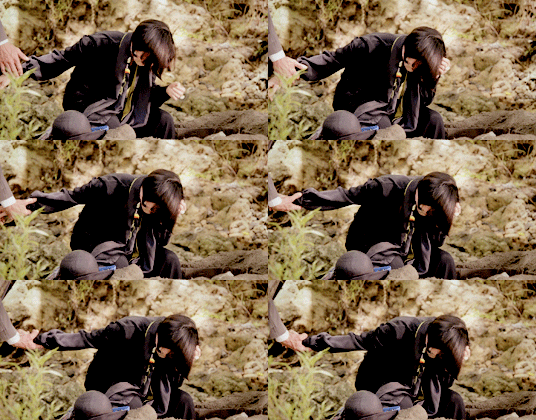
Phryne's own actions during the first season of Miss Fisher's Murder Mysteries also go totally against Guido's quote. During the first season she needs not only to face Foyle and Jane's kidnapping/murder, but also René and she comes out of all of it stronger. I find the moment when Phryne reaches out her hand and Jack grabs it at the site where Jane's body has been buried a prof of how much she has evolved throughout the season in regards to having people around. She's not fleeing. She faces her past, present and future all at once. She lets people in. They are not only black silhouettes. They are there to catch her when she falls.