måndag 27 februari 2017

Karin Boye - Kallocain

I have understood that recent events in the world has made George Orwell's dystopian book 1984 popular again. I definitely see the reason to compare it to the world of today, but I want to tell you about a Swedish book that is not so famous, even though it has been translated to other languages than Swedish. It is called Kallocain and was the last book written by Karin Boye who commited suicide only months after it was published in 1940.

The book is about the chemist Leo Kall who tells the story of his life. He invented a truth serum called kallocain for the totalitarian Världstaten (World State) which controls everything in its citizens lives. The kallocain gives the state a way to control people's inner thoughts as well. However, listening to them has a side effect on Leo himself. He starts to question the teaching and the propaganda of Världstaten.

Considering it was published in 1940, it is easy to see that Boye mainly got her inspiration from the situation in contemporary Germany and Russia where the state required everything from the individual. The citizens should be submissive and obey every whim from the regime. Just like the regimes in Germany and Russia, Världsstaten also stalks, tortures and kills disobediant citizens. Feelings (especially of the more empathetic nature), humanism and free thoughts needs to be supressed totally and everyone needs to make huge sacrifices in the name of the state (such as giving up your own children to the state!) without blinking. The book also uses a lot of military terms, so you from the very beginning realise that the regime is into warfare. Everyone wears uniforms (special ones for every occasion) and the children are taught to play war from a very young age (They even uses explosives and has their own guns!). I also cannot help thinking Karin Boye wanted to criticise the view of science at the time. I do believe that science is good and things need to be scientific, but during that time, it was from time to time misused to devastating purposes.

Boye's language is very austere, but the pace of the story is rather hectic. It is easy to read, but you still need to stay with it all the time. It is a very thought-provoking book that unfortunately is still relevant today. While Orwell's future is in the past (1984), Kallocain is set in today's present (the 21st century), something that, to me, makes it a bit scary based on the current political situation we see througout the world.

torsdag 23 februari 2017

Blood and Circuses - TV vs Book

"Justice, not money, determines the cases worthy of my attention."

~Phryne Fisher, Blood and Circuses (TV)

As I said in my entry about the book, there are a lot of different thoughtprovoking issues in Blood and Circuses and I probably get back to it in the future. It was however one issue that was more prominent than others to me and it was how both versions of the case at the circus sort of got to Phryne Fisher herself, but in different ways.

Phryne, Dot and Jane sneek a taste.
I had really decided I was going to leave Phryne as a character pretty much alone until I had read through all the books, but after reading this book (and to some extent also after a person I like said Phryne was only a shallow James Bond character), I figured I needed to address her character pretty much immediatelly, but first I will do a recap of the plot of the TV episode and how it deviates from the book one.


Just like the book, the TV episode starts with Mr Christopher (here called Miss and is considered a woman) and the episode starts with her being found strangled, stabbed and with a python around her neck in the magician’s vanishing cabinet (overkill as Phryne calls it) during the circus Farrell’s show and not in his bed at the boarding house where he lives in the book. Not pleased with Senior Sergeant Grossmith who has been assigned to the case, Phryne’s old friend Samson(Sam) seeks Phryne out to try getting her to help. For once, Phryne is rather reluctant to go back to Farrell’s since it was there that her little sister Jane disappeared while Phryne was too caught up in the magician perform a vanishing act in the same cabinet (at least I think it is) that Miss Christopher is found dead in. 


Jack and Elsie share a moment.
The TV episode is not one of my favourites. It is quite messy and it is not made clear exactly who made what and why. However Elsie Tizzard is probably my absolute favourite among the minor characters. I love her special relationship with Jack, but also how she bonds with Amelia Parkes in the cell. The latter is just one of all the amazing depictions of female friendships that we can see throughout both TV and book series.

Another aspect I really enjoy as an archaeologist is how they have used how memories (even unwelcome ones) are triggered by materialities. Phryne is extremely reluctant to go (back) to Farrell's circus to investigate and it is not until Jack (for once) gives her a definite no that she agrees to Samson's request and takes on the case. When she gets to the circus, the memories become even more prominent and we get much longer flashbacks with Jane and Phryne at the circus. Correct me if I am wrong, but I also think this is the first time we really get to see Janey Fisher's blue ribbons.


We have seen Phryne vulnerable before, but the memories of Jane are humbling in a new way. They seem to give her new insights into what happened to her sister and the episode itself sort of works much more as a build-up to the two that follows it.
'Tonight you shall share my luxury', she said, pulling off the dress and the scarf and shedding battered undergarments, 'because tomorrow I shall share your poverty.'
~ Kerry Greenwood, Blood and circuses (book) 
Phryne and Samson
In the book, Phryne goes through an even more humbling journey. She is forced to leave her luxurious lifetotally behind as she goes undercover as Fern Williams, the trick rider at the circus. Like Peter Smith, the anarchist, does in the Death at Victoria Dock book, Mr Burton questions what she does at the circus and Phryne gives him a similar answer that she is tired of being said not to understand or being able to manage a more simple life because of her otherwise privileged lifestyle. Because the Janey Fisher/Murdoch Foyle plot was made up for the TV show, the circus does not provoke as many bad memories for Phryne as in the TV show, but it does turn out to be a very hostile environment.

Little Phryne and her sister Jane in one of the flashbacks.
Like the TV episode, the book works a lot with materialities, but instead of connecting them to memores, it connects them to Phryne's self-esteem and confidence in a way that had me thinking of the song Wig in a Box from the musical Hedwig and the Angry Inch.

The musical is about trangendered Hedwig who goes through sex reassignment therapy, but the surgery goes terribly wrong and she is left with an "angry inch" and in a state of not belonging to either of the binary sex/gender construction that is still considered norm in today's Western society. As you might understand, this can in many ways be related to the transgender theme of both book and TV episode (In the TV episode, we even get to know that Miss Christopher pays a surgeon to have her "additional appendage" removed.), but in many ways it can also be related to Phryne as a character.

Kerry Greenwood made a cameo at the circus in this episode.
As I have said before, I do not like the comparisson of Phryne to James Bond. I actually find it a bit degrading of her character. Phryne is so much more than just a female version of the action male archetype. Yes, she is wild, adventurous and reckless, active in every scene she is in (traditionally male traits), but she is also empathetic, compassionate and kind (traditionally female traits). She does not show many emotions (male trait), but she is sensitive to other people's needs (female trait). (I admit the latter does not always apply to Jack, but in that case it has much more to do with him not behaving like a traditional male way.) She is cunning and clever (male traits), but also flirty and seductive (female traits). She also uses violence and reacts to it in a very different way than Bond (or for that matter Indiana Jones who she is also compared to). Even though she often brings her golden pistol with pearl handle and has a dagger in her garther, she does not use them other than when it is totally necessary to save herself or others. I agree that her wild, reckless and sexual side is far more conspicuous, but I think we more should ask ourself why that is instead of only calling her a female James Bond/Indiana Jones.

Her overall apparence is also totally female with her beautiful, often very feminine clothes, hats and red lipstick. This is also where the relation to Hedwig and the song Wig in a box becomes most apparent. Like Hedwig, Phryne has a dark past which has been made clear at this point in the TV series, but not in the books, so I will leave it until it is brought up. Both of them also hits rock bottom, but they decide to turn their life over and they both sort of find exuberance in fashion. This is also how the book points to the material aspect of Phryne's identity and how important it is to her.
She was feeling of balance. Deprived of her usual props and stays and allies, and having to speak with the accent of her childhoo, she was losing confidence. No one seemed to like her, and she was used to being liked, or at least noticed. She closed her eyes.
~ Kerry Greenwood, Blood and Circuses (book)

Jane asks Samson for stories about Phryne.
In a way the circus makes her time-travel back to her childhood in poverty in Collingwood, leaving her feeling self-concious and lonely. When the clown Matthias/Jo Jo does her make up for her performance in the circus show, she does no longer recognise her face, seeing only a stranger in the mirror.

But again it is a material object that destroys her identity all together. When she is discovered by Jones and his men and they are about to rape and kill her, they take away both her clothes and the belonings she has hidden underneath and inside them. Among those is the St Christopher medal Dot gave her right before she was leaving her home.
She made no sound until he broke the thong which held the holy medal and pocketed it. Phryne gave a pitiful cry. Her last link with her own self was gone.
~ Kerry Greenwood, Blood and Circuses (book)
The medal triggers a basic instinct inside of Phryne, making her fight the men. Because she is no simple "damsel in distress", she manages to avoid rape, but she does not win her freedom. Instead Jones and his men locks her in an animal case calling her a "wild beast".

This is actually not the first time in the book where humans have been compared to other animals.This is actually a theme also woven into the plot. Trapped in the animal cage and naked, Phryne's identity travels even further back in time (The mentioning of her friendship to the archaeologist being extremely fitting in all of this). Her fear of the lions was established already as Dulcie showed her around the circus and is already then said to enhance a primitive version of herself. She, however, remains quite active, trying to get herself out. In the end though, she realises she might need help from a friend or two. Humans are, after all living in hoards by nature...

tisdag 21 februari 2017

Kerry Greenwood - Blood and Circuses

I think this is my favourite among the
art deco-inspired covers.
Blood and Circuses is the sixth installment in the book series about Phryne Fisher by Kerry Greenwood and they just keeps getting better and better. The plot surrounds Farrell´s Circus where a lot of things seem to have gone wrong lately. The latest "mishappening" is the murder of the circus artist Mr Christopher. Some old friends from the carnival following the circus, turn up at Phryne's door to have her investigate what is really going on over at Farrell's. Phryne therefore decides to go under cover as the trick rider Fern Williams.
The circus was vast and bewildering. The number of people who might want to destroy it was unknown and it seemed impossible to keep tabs on everyone. Phryne was concious of being alone in shabby clothes and completely ignorant. You've bitten of more than you can chew this time Phryne, she thought. You'll never make any sense out of this. 
'To understand a circus', she added alound, stepping sideways to avoid a passing camel, 'you obviously have to be born in a trunk.'
'Too right', agreed Dulcie.
At the same time, detective inspector Jack Robinson starts looking into the murder of Mr Christopher together with sergeant Grossmith and constable Tommy Harris. The latter is saved by Amelia Parkes, one of the women living at the same boarding house as Mr Christopher. She has a dark past and is therefore accused of the murder almoste immediately. But things is never as it seems at first.

There really is a lot to talk about here. Not least identity issues due to the victim being androgyne. But since my thoughts about identities to a great proportion involves Phryne to a great extent, I have decided to leave it for my TV vs Book post about Blood and Circuses.

Essie is very beautiful and all, but why not
use a picture from the TV episode with
Phryne dressed as Fern?
Instead, for this entry, I have decided to talk about the, sort of new world, Phryne gets herself into when she goes under cover as the trick rider Fern.

The title is an sort of paraphrase of an expression coined by the Roman poet Decimus Junius Juvenalis panem et circenses (Bread and Circuses - Bröd och skådespel in Swedish). He was not pleased with the decadence of the Roman Empire claiming the politicians kept the population at bay by feeding and entertaining them. It was during this time that emperor Vespasian made the Colosseum, which probably added more argument to Juvenalis proclaim that the distribution of cereals, the spectacles and the gladiator games all was just a trick to have the lower classes thinking about other things than social issues.

The circus in Kerry Greenwood's book however is the modern type which originated in 18th century London where Philip Astley held shows which mainly featured riders doing advanced tricks on horses.

Interestingly, Astley had discovered that a circular shaped stage (the ring) had several benefits. Not only could you get a bigger audience because they were able to surround the stage in stead of just sitting on one side of it. It also proved to help with the horse tricks. The ring helped the horses to gain speed because they could keep going around and around instead of having to slow down to turn every once in a while. This created the centripetal force which helped the riders to stay on.

In Sweden, the history of the circus phenomena can only be traced back to the early 1900s, but there had been travelling menageries before that. Among the artists were often families belonging to the Norwegian and  Swedish Travellers.

I really enjoyed how elaborative Greenwood's description of the circus was. Instead of just writing that  Dulcie shows Phryne/Fern the circus, we are actually getting to follow them around, meeting the people and the animals there.

The circus is described as a society in its own with its own social hierarchy: circus folks-carnies-gypsies*. Among the circus folks there are also a smaller social hierarchy with flyers being seen as the nobility and the others pretty much as simple peasants according to the dwarf* Mr Burton.
'You were at Oxford University?' squeaked Phryne. 'Then what are you doing in Farrell's'
'Where else could my... deformities be valuable? Everywhere else I am a freak. Here I am still a freak but I am a performer. Circuses are the only places where dwarves can get some respect.'
The fact that people who deviated from one or many of the societal norms were more or less forced to be performers at the circus are actually rather terrible. I had encounter it before in history books and in other forms of popular culture, for example Phantom of the Opera, but I still feel terrified by the view on humanity that society had.

I think the Phryne Fisher books just keeps getting better and better. It had a slow, somewhat boring start, but then it really hit of and even though I sort of figured out who did what somewhere in the middle, it did not really matter. And I love that Phryne has a friend who's an archaeologist.


The photo of the Essie Davis cover of the book was borrowed here.
*I know it is preferable to use other terms than these, but they were the ones used during the 1920's which is probably the reason why Kerry Greenwood 

fredag 17 februari 2017

Historical Women - Ecsedi Báthory Erzsébet

Erzsébet
Ecsedi Báthory Erzsébet, or Countess Elizabeth Báthory as she is known in Western tradition, was born in Nyírbátor in Hungary in 1560. We know that her family was wealthy and her uncle and grandfather are said to have been the two of the mightiest men in the country at the time.

Erzsébet learned Latin, German and Greek and had great influence in the contemporary Hungarian nobility. When she was eleven years old, she was betrothed to Ferenc Nádasdy who was the son of a baron. The wedding was held when Erzsébet was 15. Because she was marrying down, she kept her family name and as a wedding present, Ferenc gave her the castle Csejte in the Carpathian Mountains and the 17 villages that belonged to it.

Ferenc went off to war against the Ottoman empire in 1578. This meant that Erzsébet was left in charge of her household, but also for the Hungarian health care. During this period, she not only cared for her family and staff, but for women in precarious situations. What is interesting is that there is nothing from this time period that indicates what is said to have happened after Ferenc died in 1604.

Also based on what is about to come, there is absolutely no reason to accuse Erzsébet of murdering her husband. He seems to have died of an illness he had had for three years. She also seems to have been very happy in her marriage with him. They had five children together. (There are rumours about some bastards too, we do not know for sure.) Ferenc left the responsibility for his family to his friend  György Thurzó.

Already in 1602 there had been rumours that not everything in the castle Csejte was as it should though and a lot of complaints were made to the government between 1602 and 1604 and around 1610, they finally decided to look deeper into them. For two years they collected over 300 witnesses from priests, the nobility and the lower classes which resulted in a horrifying tale if it was all true.

Erzsébet is said to have held her servant girls chained with their hands in the air during the nights so they became blue and bled. She shall have also beaten them so badly that they had to use ash and cinder to shrape the blood of the walls. She is also said to have burnt her servants with metal rods (some of them, she shall have stuck up into the genitals of the victims), glowing keys and coins and burnt their soles. She shall also have stabbed them and poked them with needles in their eyes, tongue and underneath the nails. One also believed her to cut their hands, lips and noses with scissors.

To destroy the genitals of her victims, she is also said to have used needles, knives, candles and her own teeth and she shall also have sown up their mouth with needles and threads. There are also lots of witness accounts proclaiming that she forced her victims to sit in, bathe in nettles and/or that pushed nettles into their shoulders and breasts. Some is also said to have been forced to stand in containers with ice water up unto their shoulders until they frose to death.There is also a story of Erzsébet having daubed a girl in honey and left her outside to have insects sting and eat off of her.

There are also stories about Erzsébet starving her servants one week at a time and forced them to drink their own urine. They shall also have been forced to cook and eat their own flesh or serving it to guests.

In 1610 György Thurzó went to Cstejte with an order from the government to arrest Erzsébet and he is said to have caught her in the act. At the time you were allowed to beat servants, but everyone agreed that Erzsébet had gone way out of line.

She is thought to have killed over 650 young girls. At first from the lower classes, who worked as servants in her castle. No one reacted, however, until she moved on to more higher classes of society. there are testimonies that she kidnapped girls from the 17 villages that belonged to the castle when the lower classs girls stopped coming to her. When György Thurzó came to the castle, he is said to have seen one dead girl, one girl who was dying and a lot others who was locked in cages.

Erzsébet social status meant that she was first sentenced to be forced into a convent without trial, but as the terrifying tale was exposed, the government decided that a trial was needed. There were lot of witnesses and only one of them gave a statement against the accusations. There was also an investigation of the skeletal remains that were considered evidences. Three of the servants who was thought of as Erzsébet's helpers were sentenced to death. Erzsébet's punishment was to spend the rest of her days locked inte on of her castle's tower. She died there four years later.

There are a lot of myths and legends told about Erzsébet. For example a talein which she is supposed to have bathed in the blood of young girls exists too, seems to be several hundred years younger. Before all the rumours started in 1602, she is not portrayed as a monster at all even though she is said to be a very strict employer. The letters and other texts she wrote does not give any indication of her being crazy. Therefore it is hard to know if there are any truth in the stories of what she is supposed to have done to all those girls or if she was just considered dangerous because she was a woman in a powerful position.


Sources: 
I got this story from the user eeriedearie on Twitter. She tweets stories about serial killers in Swedish

måndag 13 februari 2017

Can one criticise something one loves?

Trowel, common tool for an archaeologist
On 29th January I published an entry about differences in how minor characters and older plots are handled differently in Miss Fisher's Murder Mysteries from The Phryne Fisher books. That entry seems to have evoked some reactions (which I absolutely love, there is far too little of response to my entries most of the time). However, it also had me thinking a lot, which is why I have had to forego my "rule" of posting something at least once a week.

Essie Davis
Photo: Rachell Smith, United Agents
As you might understand from the title of this entry, I intend to discuss if it is possible to remain critical if you start loving it. Although the topic arose from a post about the franchise surrounding Phryne Fisher, I do think it is important to widen it and talk about all the things that I am nerdy about. It varies a bit, but at the moment, my main favourites are Miss Fisher's Murder Mysteries and the Phryne Fisher books, Horrible Histories, Yonderland, Archaeology, History, Osteology, The Vasas/ The Tudors, Vikings and the Middle Ages, the seven original Harry Potter books, Essie Davis, Nathan Page, Ola Salo and last, but not least Simon J Berger. As you might understand the last four are real people who I do not know personally. Therefore they will be left a bit out of this post, even though I am sure they have flaws as well. No one is perfect after all and I do think it is important to be able to see the flaws of something and still love it. Let me give you some example of the fictional things that I love.

Nathan Page, Photo: Sam Mcadam-Cooper
My most recent nerdiness (and the thing that begot this very entry) is, as I have already said, the Phryne Fisher franchise. Therefore I will start there. I love it, but even I have to admit that there are certain flaws to both books and TV show. The books tend to be too overflown with characters (This does not mean that I do not think they reuse older characters in a good way, because they do!) and a lot of them are called Jack from time to time. It gets even trickier since both Bert and Cec and minor characters also call policemen in general "jacks".

The TV series is unbelievably beautiful and the clothes are to die for. However, it still sometimes fall short in regards to the plots. That is not why I watch the show and love it. I love it because of the world it builds up and the characters who populate that world. My view on the show is actually pretty much the same as Essie Davis. In an interview she did with David Stephenson back in 2014, she said that the show is structured like a murder mystery. However, it is much more about the world it creates (each episode is a new one) and the rather mismatched family Phryne Fisher creates around herself. This is exactly why I do love the show and which is why the flimsy, sometimes illogical plots filled with plot holes do not matter at all.
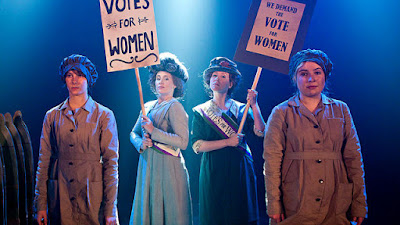
Horrible Histories Suffragettes

My second largest favourite at the moment is the British, sketch show Horrible Histories. I know it is aimed towards children, but it is just as funny and entertaining for adults. I love the idea of using humour to get people interested in the past. Learning does not need to be boring. I also love that the show (I have not read the books that the show is based on.) really gets you interested and encourages you to look things up for yourself. It also has the most historically accurate portrayal of the Tudor dynasty in popular culture. I do have some problems with most of the Stone Age sketches though.

Human skull on stick from the Mesolithic
settlement Kanaljorden in Motala, Sweden.
Photo: Fredrik Hallgren, KM
As I said in my entry about the Savage Stone Age back in June last year, a lot of the sketches about the Stone Age in the show paints a rather stereotypical and outdated pictures of the time period and how the humans lived back then.

The Stone Age, especially the Paleolithic (older Stone Age) and the Mesolithic (middle Stone Age) was a long time ago (The dates varies a bit in different parts of the world, but to go  by Wikipedia the Paleolithics are estimated to have lasted between 2.6 million and 12 000 years ago and the Mesolithics 12 000 and 5000 years ago.) and our knowledge about the time period is also extremely fragmented and new archaeological find can turn everything upside down entirely.

To understand the image of the Stone Age one also needs to know some things about the research history of it. Historical time periods are constructions of scholars in later years (mostly the 19th century). While other time periods were created to be the ancestors of the Western nation states, the image of the Stone Age was considered to be humans in a less evolved state. The model for the Stone Age humans were actually non-westerners like Native American and Aboriginal groups of the Americas and Australia who Europeans met through colonial encounters. This makes the Stone Age people not only be separated from us in time, but also in space. They were not supposed to be "us", but something else.

Simon J Berger
Same goes for the Neanderthals. They are, more naturally, considered to be a different race. However, the assumption that they were "savages" come from a misinterpretation of a bural of a 45 years old male Neanderthal in France 1908 who was crippled by difficult rheumatism. Besides this, recent years study of their and our DNA has also shown that the picture is not as simple as first thought.

The fact that Horrible Histories actually uses a traditional way to depict the Stone is lamentable. It justify and even enhance the picture of a regressive time period inhabited by "creatures" far away from ourselves. There are some exceptions to this however. For example the sketch I talked about in the entry I linked to above.

Ola Salo
By analysing and telling you all this, I hope to show how important it is to actually be able to see the flaws in something one loves. It creates a distance that I think is healthy.

There are also some examples where directors have achieved status as "legends" for previous works. This seems to have led to no one daring to criticise them in their next productions. At least not until the films have had prèmiere. As you might have guessed, I am mostly thinking about George Lucas in regard to the Star Wars prequels and Peter Jackson's Hobbit films. In fact the need to discuss this topic has also a little to do with me discussing the Hobbit films with a Lord of the Ring loving friend who started defending the decisions Jackson made while doing them.

I love the Lord of the Rings films and I can see them over and over. I also love the Hobbit book. I do not really see it as this huge fantasy epos that the Lord of the Rings books and films are though. It is an adventure story aimed mostly towards children and that is what I think should be reflected in the film version too (Same goes for the new Narnia films by the way.). The Hobbit films also suffer from the same problem that the Harry Potter films do: It focuses on the wrong things and does not really advance the main plot most of the time.


The Harry Potter franchise is actually very interesting in relation to the topic of this entry. The Harry Potter fans tend to not have any problem with finding flaws about just about everything about the Harry Potter universe. They are also not afraid to share their view with others, which leads to rather interesting discussions among the fans I can tell you. Most of the fanbase also seems to have totally dismissed The Cursed Child and no wonder since it goes against pretty much everything the original books stands for! I am not a fan of the films either. For example I have no idea how they could turn one of the darkest books (Harry Potter and the Half Blood Prince) into a romance, but that's just me.

Cecilia Vasa, Princess of Sweden
I know this entry is already extremely long and I aplaud you if you stick with it this far. My biggest interest is archaeology and history of all kinds really, but I prefer the time period between the later Scandinavia Iron Age (about the 5th century AD) up until the early 17th century. This is a subject that is not just a hobby to me. It is also my profession. This, I think, creates a need to distance myself from it. A lot of (at least Swedish) archaeologists often say that archaeology is a lifestyle.

In his interview with Sherri Rabinowitz for her podcast Chatting with Sherri in October last year, Nathan Page talked about how his family prevents him from going into a bubble whenever he is doing a play. Even though I do not do plays, I can understand the bubble. Dealing with a research project or an excavation tend to consume you quite a bit and nothing else really seem to matter. Even if it is a wonderful feeling at the time, it can be dangerous. Not least since you can burn yourself out. As a researcher I also find it very important to be critical both to your own subject and to the research tradition that comes with it. As I have already said above, archaeology is a subject with its roots in a Western colonial tradition and the research has from time to time been rather biased and nationalistic. Therefore it is very important to remain critical towards the whole research field.

Gamla Uppsala, Sweden
I can definitely see why people see it as a lifestyle. It definitely changes your perspective of the world. However, if you have it as a profession you sort of need to not go totally into that bubble. Besides the reasons given above, it also tends to make you a rather boring person to hang out with. You can ask just about anyone of my friends and family how much they hated the Christianisation, colonial theories and burial customs during the late Viking Age and early Middle Ages as I was doing my MA thesis!

So to sum everything up and answer the question asked in the title of this entry: Yes, you can and you should critise the things you love. It keeps you grounded in reality and also your feelings for it can deepen because of it.


Sources:
David Stephenson's interview with Essie Davis (2014)
Sherri Rabinowitz's interview with Nathan Page from her podcast Chatting with Sherri (21 of October 2016).
The photo of Essie Davis was borrowed from United Agents webpage and was taken by Rachell Smith.
The photo of Nathan Page was taken by Sam Mcadam-Cooper as part of their ongoing collaboration.
The picture of the Horrible Histories Suffragettes did I take from Tumblr. 
The photo of the skull from Kanaljorden in Motala, Sweden was borrowed from Stiftelsen Kulturmiljövård
The picture of the Swedish Harry Potter book covers were borrowed from here. 
The photo of Simon J Berger was borrowed here. I have no idea who the photographer is, because it is not included on the webpage where I found it.
The photo of Ola Salo is from frontface.se.
The photo of Cecilia Vasa is from Wikipedia.

söndag 29 januari 2017

Some more thoughts about the Phryne Fisher universes

The main characters of Miss Fisher's Murder Mysteries
After having fun with Historical Women, Female Archaeologists and actually a lot of Ancient Egypt, I thought it was about time that I went back to Phryne Fisher.

As is probably quite obvious from this blog, I love Phryne. I think she is such a wonderful character and both TV and book series are amazing. There are some differences between the two media though which I discuss from time to time in the series of entries I have chosen to call Miss Fisher's Murder Mysteries -TV vs books. This entry will be part of that series, but instead of talking about a certain book and its TV counterpart, this one will discuss a more general trend I have noticed that is different.

Up until this point, I have only read five of the Phryne Fisher books and, after a short hiatus, I have just started with the sixth (Blood and Circuses). There are a lot of books that I still have to read, but I think I can still discuss this and there is a chance I have reasons for returning to the subject further on.

In the TV series, Phryne creates a sort of family that more or less provides her with stability in life. Only one of these people is related by blood to her (Her aunt Prudence.). They are a bit mismatched with communists, policemen and strict Catholic girls for example, but they turn out to work extremely well together and also with Phryne. (This is a subject for a different entry though, so I will not go into it so much.) Besides these nine people making up Phryne's family, there is not much consistencies to Phryne's friendbase. People come and go and we hear they have a past with Phryne and some of them might be "old friends", but we tend not to hear about them either before or after Phryne and Jack have solved the case they are part of. There are a few exceptions to this. Most of them related to the over-arching plotlines of each season like Murdoch Foyle in season one and Phryne's father Henry Fisher in season three. In season two we also get to meet Jack's ex-wife Rosie Sanderson who is introduced already in season one (when Jack is still married to her), but is only talked about then. These characters are in more than one episode, because their plot stretches out for more than one episode. Another exception is Lin Chung. He is in two different episodes with two different plots although his part is sort of the same (being Phryne's lover). From what I have gather he is a much more of a recuring character in the books, but I have not got to him yet, so I have to leave it for the time being. (I cannot think of any more minor characters that are in more than one episode. Please help if you come up with someone!)

On the contrary, the books reuse a lot of characters and also plot points. Phryne still builds a family around herself containing mostly the same people. There is no aunt Prudence, but Mrs Butler and Ruth. The latter I will get back to in a bit. Detective Inspector Jack Robinson has a different role in the books and is not as close to Phryne as he is on TV, but I think he still can be classified as a family member. Not least since one of the few times he is mentioned in Death at Victoria Dock is in the context of having given Jane and Ruth a record player.

Then Phryne also has friends who she surounds herself with on a more distant level. She still calls them when she needs them to help her out on a case and she seems to meet up with them from time to time. These characters are reused and we also get to hear how some of the minor characters (both friends and others) do after their plot has been finished. For example Bobby Matthews who we encounter in the very beginning of Cocaine Blues and who we later hear from in Murder on the Ballarat Train in relation to Eunice Henderson and her mother. There are also a couple of characters that I have a small feeling will return later on, but I will not tell you whom since I do not trust you not to spoil me.
'I feel a bit shaken, but I'm all right, Dot, don't fuss. This is not the same as that other time. I didn't see this man die.'
~ Phryne Fisher, The Green Mill Murder, Kerry Greenwood
There are also some mentions of past cases and not just in a recap sense, but more woven into the plots of other books. For example when Dot asks Phryne how she is after hearing Phryne has encountered another murder in The Green Mill Murders. This is a reference to Phryne being shocked and upset by the death of Yourka in Death at Victoria Dock.
Hugh: "Miss Fisher's gone on holiday again Sir."
Jack: "Hm. Anyone dead yet?"
Hugh: "Only one so far Sir..."
~ Murder under the Mistletoe
Jane and Ruth, Murder on the Ballarat Train
I do understand the need to simplify things for the TV adaptation, but the reuse of characters in the books makes book-Phryne's universe feel more real and thriving. In the TV series it sometimes feels as if you either die or kill someone if you do not belong to Phryne's inner circle. The TV series is very good at reusing clothes and accessories though and also in how they are worn. The men, like Jack for example, have a pretty limited range of clothing, but they can vary small things like ties, which makes the male clothing a bit less uniform. When it comes to the minor characters however I would love to see or hear more about many more of them. A lot of them are actually very interesting and some of their stories are left more or less unresolved.

To take Ruth for example because she is probably the most important character from the books that is not important in the show. She is in the Murder on the Ballarant Train and just like in the book she lives (and slaves away) in the same boarding house as Jane and they are really close.The police finds her grandmother in the end of the episode and she goes away to live with her. But if she and Jane were so close, why would she not come around to the house to see Jane? And would she not fit into the group of flower maidens Phryne trains in Queen of the Flowers? I do not think Jane would stop seeing her and/or that Phryne would not let her. So why can she not appear as Jane's best friend?

I do not expect every minor character to turn up again or Phryne to have any sort of contact with that we get to hear. Some of them are just so fantastic that I find it sad. Besides, we do not even get to know if Jack and his police men were able to catch Lydia Andrews and destroy the cocaine trade after the events in Cocaine Blues.

måndag 23 januari 2017

Justin Kurzel - Assassin’s Creed

Today marked the first time I saw Essie Davis on the big screen in Assassin’s Creed. Her husband, Justin Kurzel, was the director and Michael Fassbender played both main characters Callum Lynch and Aguilar de Nerha.

Callum lives in the present and is a criminal given the death penalty but later wakes up in a medical institution where he gets involved in Sophia Rikkin's (The daughter of a knights templar.) experiments where she tries to find a solution to all the violence in the world by collecting the assassins from the Middle Ages and using their genetic memory.

I have not played the video games and this might be why I found the plot very confusing. The part I did understand though felt rather intriguing and I think the film could have been longer so it had time to dvelve into more detail of the genetic memory and the film would also have gained a lot from exlplaining Sophia's reasearch and the reasons and logics behind her science and experimentations on people. The non-linear storytelling would also have benefitted if the film had more time I think. As it was now, it jumped far too quickly between different time periods and places and made it feel rather messy.

The visual style was beautiful and the actors were all rather good. It also had more women than I would have guessed and they were also quite diverse. I also thought Sophia was far more interesting than Callum. I would have liked to get to know much more of her background. The film does not really solve any plot points either and the ending feels made for a lot of sequels to follow it.

Essie Davis as Callum's mother

Cinema tickets
It is pretty obvious from this blog that I do love Essie Davis! But I am not sure I would have seen Assassin's Creed at the cinema if I had not had free tickets. If she would have been the lead, I would not have hesitated for a minute, but she is in it far too little for me to go straight to the movies to see it. I am glad I had a free ticket I needed to use before Wednesday and therefore got to see it and because of Essie I would probably have seen it at some point. Essie is in less then ten scenes and has only two or three lines in the entire film, so definitely too little Essie! It felt like a vaste of her talents by her husband, but I am still very thankful that they do both have their own careers away from each other. There are a lot of times in relationships between famous actors/actresses and filmmakers where this is not the case and you end up wondering if the actor/actress only got the role because she/he was sleeping with the director/producer/etc.


Picture from here and here.

söndag 22 januari 2017

Historical Women - Merit-Ptah

For this third entry to my Historical Women series I am staying in ancient Egypt, but moving further away in time from Hatshepsut. This woman was called Merit-Ptah and we do not know that much about her other than what can be seen and what is said about her on a tomb in the necropolis close to the step pyramid in Saqqara.

Her name means Beloved of the god Ptah and she was born either during the 2nd or 3rd dynasty in ancient Egypt. Her son was a High Priest and describes her as Cheif Physician which makes her the first woman in history, known by name, that praciticed medicine and she might also be the first known women in science.

She is not to be confused with the wife of Ramose, the Governer of Thebes and Vizier under Akhenaten who shared her name.


Pictures were borrowed here and here. Facts were taken from Wikipedia.

onsdag 18 januari 2017

Female Archaeologists - Gertrude Caton-Thompson

Gertrude Caton-Thompson
While thinking of my Historical Women series, I also thought about how many amazing female archaeologists I know of and who also deserves a place in the spot light. Though technically, they can also be viewed as "Historical Women", I have decided to give them their own category. Not least, to present a more varied picture of my own profession.

Dwelling into the research history of archaeology, one actually find rather a lot of different women who worked on excavations with or without men (mainly their husbands). It seems to have been particularly easy for American, British and French women to do archaeological work in the colonies. They also seem to have had it easier if they had worked with something that their contemporary society (late 19th and early 20th century) thought of as fitting for a woman. There are quite a lot of nurses among them for example.

Many of these female archaeologists worked in their shadows of their husbands and have become marginalised in the research history because their texts were published in their husbands's names. There were also quite a few women working in archieves and museum storehouses who's work never really classified as archaeology wherefore they are never mentioned in research historical overviews. Quite a few of them, however, did have an obituary. Not least the archaeologist I intend to devote the rest of this post to. Her name was Gertrude Caton-Thompson and she was born in London in 1888. Her interest in archaeology was founded when she visited Egypt together with her mother in 1911 and afterwards also visited Sarah Paterson's on Ancient Greece at the British Museum. She inherited money in 1912 which made her financially independent and studied both a Cambride and University College London from 1921 onwards. Among her teachers were Margaret Murray, Dorothea Bate and William Matthew Flinders Petrie. She participated in quite a few excavations in Egypt during the 1920's. Not least in the Faiyum oasis with geologist Elinor Wight Gardner in 1925.

Part of Great Zimbabwe
Her most famous excavation is that of the remains of Great Zimbabwe close to Masvingo in what was then known as Rhodesia, but that we today call Zimbabwe. The remains had been known by Europeans since the 16th century when Portugese soldiers at the coastal fort in Sofala in Moçambique heard tales of great remains deep inside the heart of Africa. The first European to visit the remains was the German geologist Carl Mauch in 1871 and Gertrude's countryman J. Theodore Bent was the first to do any archaeological work of the remains at the end of the 19th century. Bent interpreted the remains as too sophisticated to have been built by any known "African race". Instead he sought parallels with the Mediterranean and the Middle East, not least with the Phoenicians.

Aerial view of Great Zimbabwe
In 1905, the British Association for the Advancement of Science sent another student of Flinders Petrie to Great Zimbabwe, David Randall-MacIver. He debunked Bent's migration theory of Great Zimbabwe being of African origin. The was not really what the British Association for the Advancement of Science or the white population of Rhodesia wanted to hear. Not least since they used the remains to legitimize their imperialism in the area.

Therefore the association sent Gertrude in 1929. She did, however, confirm Randall-MacIver's theory of an African origin. Not least since she could find similar objects being made among contemporary native craftsmen. For this she became very impopular among the same crowd as Randall-MacIver's but she stood her ground, publishing her results in 1931. She was not totally unbiased though. After having established that Great Zimbabwe had African origin, she talks about the remains in a rather degrading way, but there is no way to deny that her research was important. She used stratigraphical methods and artefact chronology to date the site to the Middle Ages. Dates that have actually been confirmed by carbon dating today.

Gertrude died in 1985.


References:
  • Arwill-Nordbladh, Elisabeth 2003. Genusforskning inom arkeologin, Högskoleverket, Stockholm
  • Palmer, Douglas & Bahn Paul G. & Tyldesley, Joyce 2006. Arkeologins största upptäckter, Swedish translation by Kjell Waltman, Historiska media, Kina
  • Renfrew, Colin & Bahn, Paul 2012. Archaeology. Theories, Methods and Practice, Thames and Hudson, London
  • Trigger, Bruce G. 2006. A History of Archaeological Thought, Cambridge University Press, Cambridge
Picture from here, here and here.